
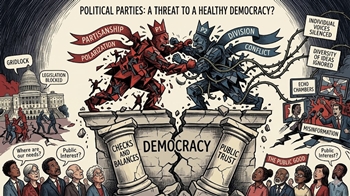
From where I sit, political parties come with this built‑in “stick together no matter what” mentality, and honestly, I think that’s insane. The idea that you’re supposed to swallow an entire platform or pledge loyalty to some politician, no matter how he behaves, makes zero sense.
Take that Big Beautiful (Ugly) Bill, for example. There’s nothing in that bill that does anything meaningful for most Americans in the long run. And yet, it sailed through Congress. Why? Because the leader of the Republican Party told his people in Congress to vote for it. And the House and Senate leadership basically snapped to attention, leaned on their members, and made sure they fell in line.
And fall in line they did. Only 3 out of 53 Republican Senators voted against it. In the House, just two Republicans out of 218 said no. The folks who voted for that bill weren’t thinking about how it would affect the people they represent. They were just doing what the party leadership told them to do. How do I know that? Why, most of them were too afraid to go home and face their constituents at Town Halls! That’s proof enough for me.
And then there’s this twisted idea that you’re supposed to be blindly loyal to the party leadership no matter what they do: behavior, ethics, corruption, none of it matters. That’s just reckless.
Honestly, if I thought a political leader had betrayed his oath of office – Republican, Democrat, doesn’t matter – I’d toss his butt under the bus without a second thought. Why wouldn’t I? He’s broken faith with his constituents, with the American people, and with the oath he swore when he took office. If I’m going to be loyal to anything, it’s to that oath. Certainly not to the guy who violated it.
You know, I’ve always felt that political parties are a real threat to a healthy democracy, and I think you can understand why. On this point, I’m right there with George Washington. He absolutely despised the idea of political parties, calling them a “frightful despotism.” In his Farewell Address, he warned that parties would turn into “potent engines” that clever, power‑hungry people could use to undermine the will of the people.
Fast‑forward 230 years, we find that Washington’s nightmares about political parties have become our reality. And my life long concerns have been validated.
The Founders’ Warning
Washington wasn’t the only one biting his nails over political parties. James Madison, architect of the Constitution, was terrified of what he called a “majority faction.” In Federalist No. 10, he basically warned that if one party gets too much power, the whole “republican principle” of voting won’t do squat to stop them from steamrolling over everyone else’s rights. John Adams was even more cynical. He thought splitting the country into two competing camps was a recipe for disaster that would breed corruption and cause leaders to value partisan victories over the well-being of the country.
A Year of Constitutional Erosion and The Abdication of Congress
You can really see the damage that the “stick together no matter what” mindset has done since Trump’s second term started back in January. Right out of the gate, he started pushing the limits of what a president is actually allowed to do. On day one, he tried to end birthright citizenship with an executive order. Then he slapped on those massive global tariffs while totally bypassing Congress. He even froze or moved around billions of dollars that Congress had already set aside for specific programs. Then he dug up some 18th-century wartime law to sidestep normal immigration rules, and even floated the idea of suspending habeas corpus for undocumented people by calling it an “invasion.” And let’s not forget the abduction of the Venezuelan president, something that’s always required a declaration of war, or at least a green light from Congress. Then there’s the whole conflict with Iran, even though the Constitution makes it crystal clear that only Congress has the power to declare war.
Although Alexander Hamilton argued in Federalist No. 70 that a president needs to be “energetic” and decisive, he was dead serious about that leader being held personally responsible for their actions. The problem today is that when a party’s obsession with loyalty shields a president from any real consequences, the very accountability Hamilton relied on to keep the Republic safe just disappears.
Rather than acting as a check on executive overreach, Republican leadership has actively codified the redirection of funds and remained silent as war powers are exercised without a formal declaration. By shielding the executive from oversight, Congress is fulfilling what Adams called the “greatest political evil”: a government where the executive is entirely unaccountable.
Conclusion: Loyalty to Country, Not Party
Every day, I’m more convinced we have to get back to the standard the Founders set: integrity over party. I don’t know exactly how we do that. But when a lawmaker ties his entire identity to a party that bows to the whims of one person, he forfeits his integrity and the party stops being a political organization and becomes a tool for tyranny. We’re all watching it happen.
As a lifelong independent, I’ve demonstrated my refusal to be manipulated and forced to accept any political agenda. However, if our representatives continue to value their “stick together” mentality over their oath to the Constitution, they’re not just failing their constituents; they’re fulfilling the very prophecy George Washington gave his life to prevent. The “republican principle” only works if the people, and their representatives, are willing to throw the “cunning and ambitious” under the bus to save the Republic. Feel free to line up behind me.