
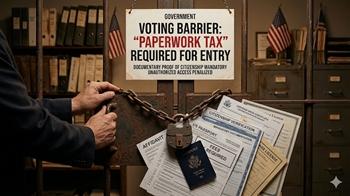
To begin, I want to explain what a poll tax is. A poll tax is a fixed fee levied on every adult as a prerequisite for voting, a practice used during the Jim Crow era to disenfranchise millions. While these direct fees were abolished in 1966, a new barrier has emerged in 2026: the Paperwork Tax. In essence, this Paperwork Tax is the sum of all indirect costs, time, and legal fees a person must incur simply to prove they’re ‘eligible’ to participate in their own democracy. But by understanding these barriers, we can better thwart the effort to disenfranchise vulnerable communities.
This modern administrative burden functions as a de facto wealth test, shifting the financial cost of democratic participation back onto the individual through mandatory document fees and bureaucratic hurdles.
Now, while the 24th Amendment to the Constitution explicitly banned the ‘poll tax,’ legislation like the SAVE America Act and the MEGA Act introduces a more subtle, yet equally effective, financial barrier designed to restrict access to the ballot box.
The Direct Costs of the Paperwork Tax
Under the SAVE America Act, the simple act of “swearing under penalty of perjury” that you’re a citizen is no longer enough. You must provide Documentary Proof of Citizenship (DPOC). If you don’t have these documents in a drawer at home, the “tax” begins immediately:
- The Passport Fee: For many, a U.S. Passport is the only “gold standard” document available. As of 2026, a first-time adult passport costs $165. For a couple living paycheck to paycheck, the “cost” of registering to vote becomes $330.
- Birth Certificate Retrieval: If you’ve lost your original certificate, states charge between $15 and $50 for a certified replacement. This doesn’t include the cost of a notary or the postage required to request it from a distant county clerk.
- Naturalization Records: For naturalized citizens, replacing a lost Certificate of Naturalization is a massive hurdle, with U.S. Citizenship and Immigration Services (USCIS) fees currently set at $1,385.
The “Marriage Tax”: A Burden on Women
One of the most significant gender-based impacts of this legislation is what advocates call the Marriage Tax.
Nearly 90% of married women change their names after marriage. If the SAVE America Act requires a birth certificate to register, a woman’s current government-issued ID (like a driver’s license) won’t match her “proof of citizenship.”
- The Linking Requirement: To register, these women must provide a “bridge” of documents, original, certified marriage licenses or divorce decrees, to prove the name change was legal.
- The Cumulative Cost: If a woman has been married twice, she may need to produce multiple court orders. Each certified copy carries a fee and a processing time that can stretch for weeks, effectively “taxing” her time and her wallet.
The “Time-and-Travel” Tax
The MEGA Act’s move to ban “no-excuse” mail-in voting and restrict ballot collection adds a physical and temporal tax to the process:
- Lost Wages: For the 30 million Americans who work hourly jobs without paid time off, the requirement to register in person or vote on a specific day represents a direct loss of income.
- The Rural Penalty: In many states, the local Social Security office or DMV, where these documents must be verified, is hours away. The cost of gas, childcare, and a full day of travel constitutes a significant barrier for rural and low-income populations.
These lost wages and travel expenses are a significant component of the broader Paperwork Tax that low-income voters must pay.
The “Fear Tax”: Bureaucratic Intimidation
Finally, there is a psychological cost. The SAVE America Act introduces criminal penalties (up to 5 years in prison) for election workers who register someone without “sufficient” proof.
- The Result: Overly cautious election workers may turn away eligible voters over minor clerical errors, such as a misspelled street name or a hyphenated last name, to avoid personal legal risk. This creates a “chilling effect” where the burden of perfection falls entirely on the voter.
Conclusion: The Paperwork Tax is a Barrier, Not a Bridge
The proponents of the SAVE and MEGA Acts argue these measures are “common sense.” However, when a “common sense” measure costs $165, requires three days of administrative errands, and involves the threat of prison for clerical errors, it’s not a security measure. It’s a Paperwork Tax designed to ensure that the ballot box is accessible only to those with the time and money to navigate the obstacle course.
Action Tip: While we work to defeat these restrictive measures in court and Congress, ensuring your personal paperwork is bulletproof is the most immediate way to thwart the effort to suppress your vote. Check your local Secretary of State’s website today. If your current ID does not perfectly match your birth certificate, begin the process of obtaining “linking documents” now.