
Estimated reading time: 5 minutes
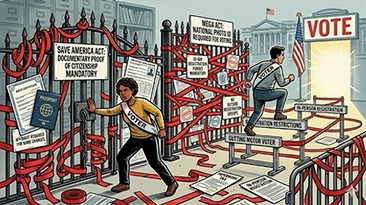
For over a decade, a specific narrative has been meticulously cultivated: that American elections are under siege by ‘non-citizen’ voters and ‘ballot harvesters.’ This rhetoric has now been codified into the federal election mandates of 2026: the SAVE America Act and the MEGA (Make Elections Great Again) Act
As the Republicans try to force these bills through the 2026 legislative session, it’s vital to understand that they’re not merely “integrity” measures – they’re a coordinated effort to reshape the electorate by federalizing restrictions that were once the domain of the states.
The Evolution of Federal Election Mandates
The path to these bills began with the 2017 Presidential Advisory Commission on Election Integrity, which sought to prove millions of illegal votes were cast in 2016. When that commission disbanded without evidence, the strategy shifted toward legislative “proof-of-citizenship” requirements.
The 2024 SAVE Act was the first iteration, focusing primarily on registration. However, following the 2024 election cycle, the effort expanded into the “suite” we see today. The SAVE America Act (passed by the House in February 2026) and the MEGA Act represent a shift from local administration to a top-down federal mandate.
How These Federal Election Mandates Restrict the Vote
While both bills share the same DNA, they target different stages of the democratic process.
| Feature | SAVE America Act | MEGA Act |
|---|---|---|
| Primary Focus | Registration: Focuses on who can enter the voter rolls. | Administration: Focuses on how votes are cast and counted. |
| Primary Barrier | DPOC Requirement: Mandatory passport or birth certificate to register. | National Photo ID: Mandates specific photo identification for all voting. |
| Registration Access | In-Person Mandate: Effectively ends online/mail registration by requiring in-person DPOC. | Gutting “Motor Voter”: Rolls back NVRA provisions, making DMV registration harder. |
| The “Affidavit” Clause | Name Changes: Allows an affidavit for name discrepancies (e.g., married women). | No Equivalent: Strict adherence to national photo ID standards. |
| The “Purge” Mechanism | Federal Scrubbing: Compels DHS to cross-check and “clean” state voter rolls. | 30-Day Purges: Mandates monthly purges and publicly listed ineligible names. |
| Ballot Logistics | Bifurcated Risk: May force states to run separate “Federal-only” and “State-only” elections. | Strict Deadlines: Ballots arriving after Election Day are discarded, regardless of postmark. |
| Criminalization | Worker Penalties: 5-year prison terms for officials who register “unverified” voters. | Possession Penalties: Federal crimes for possessing more than four ballots at once. |
| Legal Standing | Private Right of Action: Allows private individuals to sue election officials for non-compliance. | Federal Oversight: Mandates a centralized federal gatekeeper for all state voter databases. |
| Additional Bans | Identity Focus: Targets registration and identity verification. | Systemic Bans: Explicitly bans Ranked Choice Voting and “ballot harvesting.” |
| Funding Status | Unfunded Mandate: States must implement these rules without federal financial aid. | Ban on GOTV: Prohibits federal funding for registration efforts by nonprofits/outside groups. |
The Impacted Groups:
The federal election mandates of 2026 create a targeted barrier through the ‘Documentary Proof of Citizenship’ (DPOC) requirement. This mandate specifically impacts students, low-income voters, and rural citizens who may not have a passport (which costs $130+) or easy access to a birth certificate. Furthermore, millions of married women whose names do not match their birth certificates would face a ‘paperwork tax’ simply to satisfy these new federal requirements.
See that provides a deep dive into the specific economic and bureaucratic hurdles that these bills create.
The Rationale of Suppression:
Additionally, a ban on Ranked Choice Voting (RCV) and ballot collection found in the MEGA Act is framed as “preventing confusion.” In reality, RCV often favors moderate or diverse candidates, and ballot collection is a lifeline for disabled and elderly voters. By eliminating these, the legislation effectively narrows the path for any candidate who doesn’t fit the traditional two-party GOP mold.
The Constitutional Conflict: Rights vs. Restrictions
These federal election mandates of 2026 represent a direct challenge to the historical expansion of the American franchise.
- Expanding Access: The 15th, 19th, and 26th Amendments were designed specifically to prohibit the denial of the vote based on race, sex, or age. The SAVE America Act creates a de facto wealth or documentation test that mirrors the “poll taxes” banned by the 24th Amendment.
- State Sovereignty (Article I, Section 4): While the Constitution allows Congress to regulate the “Times, Places, and Manner” of elections, the 10th Amendment reserves the administration of elections to the states. By mandating 30-day purges and banning state-approved systems like RCV, the MEGA Act represents an unprecedented federal overreach into state territory.
A Guide to Thwarting Their Efforts
While the legislative landscape in Washington may seem like an immovable force, the true power of American elections remains decentralized, residing in the hands of state officials and the voters themselves. Currently, a fierce congressional stalemate has provided a critical window for resistance: while the SAVE America Act cleared the House in February, it faces a steep climb in the Senate where it lacks the 60 votes needed to bypass a filibuster. Meanwhile, the even more restrictive MEGA Act remains stalled in the House Administration Committee. This gridlock is a vital opportunity for all of us to engage in a “local firewall” strategy. By shifting focus from the drama of federal headlines to the fortification of local polling places and state laws, we can proactively ensure that Trump’s overreach doesn’t translate into disenfranchisement.
Support “Firewall” States:
We can lobby our state legislatures to pass State-Level Voting Rights Acts. States like Colorado have already created legal protections that make it harder for federal agents to seize or purge state voter rolls.
The “Dual-Ballot” Defense:
We can also advocate for “bifurcated” systems. If the federal government mandates a passport for federal races, states can still allow citizens to vote in state and local elections using existing state-level IDs.
Crowdsourced Verification:
Community organizations can begin “Document Drives” to help vulnerable neighbors obtain the specific paperwork (birth certificates/passports) required by these new laws before the 2026 deadlines.
Litigation Support:
Funding and supporting groups like the Brennan Center and the ACLU, who are currently challenging the constitutionality of these acts in federal court, remains the most immediate line of defense.
The SAVE and MEGA Acts are designed to make voting a privilege. By understanding their history and their mechanics, we can ensure that the “playing field” remains open to all of us, not just those Trump chooses to invite.