
Estimated reading time: 5 minutes
In a democracy, voters are supposed to choose their leaders. But as we move deeper into 2026, a more cynical reality has taken hold: the leaders are choosing their voters. This reversal of power is exactly why a federal ban on gerrymandering is no longer just a policy for discussion, it’s a necessity for electoral survival.
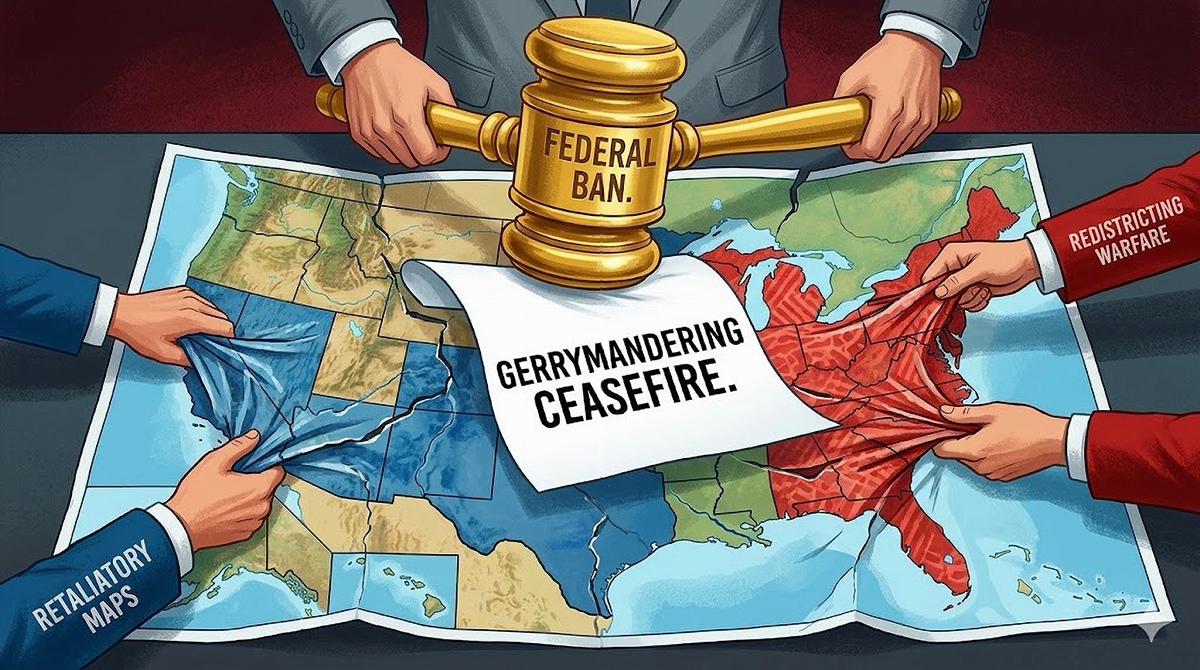
Redistricting used to be a boring exercise carried out every ten years after the Census. Thanks to Donald Trump’s push for mid‑decade map‑drawing, redistricting has turned into a political weapon instead of a neutral way to draw boundaries. The consequence is a gerrymandering arms race in which the American voter is reduced to a disposable pawn in a game driven by data, power, and self‑preservation.
The Cheat: How a Federal Ban on Gerrymandering Stops Politicians from Selecting Their Own Jury
How to Steal an Election with a Map
| Political strategists generally use two primary tools to manipulate district lines: Packing and Cracking. |
| ◈ Packing: This involves “packing” as many of the opposing party’s voters as possible into a single district. While that party will win that one seat by a landslide, their influence is wasted there, making it easier for the mapmaker to win all the surrounding districts. ◈ Cracking: This is the opposite of packing. It involves cracking a stronghold of opposing voters and spreading them across several different districts. By diluting their numbers, the mapmaker ensures that the opposing party never reaches a majority in any of those districts, effectively silencing their voice. |
Gerrymandering is, at its core, a sophisticated form of voter suppression. By using high-powered software to “pack” and “crack” voting blocs, parties can render millions of ballots irrelevant before they’re even cast. When a district is engineered to be +15 for one party, the general election is over before it begins. The only choice left is in the primary, which rewards the most extreme voices and punishes the center.
Trump’s Gambit and the Illusion of Control
The current chaos traces back to a specific demand from Trump: that Republican-controlled legislatures in states like Texas, North Carolina, and Ohio redraw their maps mid-decade to “correct” perceived imbalances. The logic was simple – squeeze every possible drop of partisan advantage to protect a slim House majority.
However, this tactic was fundamentally ill-conceived for three reasons: First, by spreading loyal voters thin to create more Republican-leaning districts, the GOP makes their “safe” seats more vulnerable to shifts in suburban sentiment. Second, in a mobile society, a map drawn in 2025 is often obsolete by 2026. You can’t trap a changing population in a static cage of lines. And third, by breaking the norm of decennial redistricting, Trump handed Democrats a moral and political green light to retaliate.
The Democratic Counter-Strike: Fighting Fire with Fire
Initially, Democrats decried the mid-decade push as a “power grab.” But as 2026 approached, the strategy shifted to maximized reciprocity. Realizing that failure to fight back would lead to a permanent minority, blue states began leveraging their own maps to offset Republican gains.
In a direct response to the new Texas maps, California voters approved a measure in November 2025 that temporarily suspended their independent commission. This allowed the legislature to redraw lines specifically aimed at flipping five GOP-held seats to neutralize the gains Trump sought in the South.
Just last week (April 21), a voter-approved referendum in Virginia successfully overhauled the state’s map, shifting it from a competitive split to one that heavily favors Democrats in 10 out of 11 districts. Here’s a shout out to Virginian voters!
New York serves as a cautionary tale. Its 2024 maps should have been the final word, yet by 2026, they were back in the crosshairs. It took a March 2026 Supreme Court ruling to halt a state-level attempt to reshape the 11th District for partisan advantage. It is a sign of the times: no line on a map is permanent when politicians can use the legal system to endlessly relitigate their own borders.
A War with No Winners
Where do we stand now? We are locked in a “tit-for-tat” cycle where the map is never settled. This instability is toxic. It discourages long-term investment in communities, confuses voters, and keeps the nation in a perpetual state of litigation. Billions of dollars are being poured into courtroom battles over zip codes, money that should be spent on the actual problems facing the American people.
The Path Forward: A Federal Ban on Gerrymandering
The only way to end this cycle is to take the pens out of the hands of politicians entirely. We need a comprehensive federal law that establishes a national standard for redistricting. Federal law should mandate that every state use non-partisan, independent commissions to draw district lines. Politicians have an inherent conflict of interest; they should not be allowed to create their own districts.
There should also be a ban on mid-decade tinkering. We must return to the standard of “one Census, one map.” The current practice of redrawing lines whenever the political winds shift is an affront to the one person, one vote principle.
Furthermore, there should be uniform standards for fairness, where federal criteria should prioritize compactness and communities of interest over partisan “efficiency gaps.”
Conclusion
The 2026 mid-decade redistricting push may have been intended as a strategic Republican tactic to ensure continued control of the House, but in the end, it may contribute to an electoral disaster. Additionally, it has accelerated the erosion of trust in our institutions and tried to turn our elections into a mathematical certainty rather than a democratic choice.
We don’t have a democracy when we have a system where the result is determined in a backroom by a mapmaker before the first vote is even cast. It’s time for Congress to act. We need a federal ban on gerrymandering to act as a floor to ensure that the power to shape our government remains where it belongs: with the people, not the politicians.