
Estimated reading time: 4 minutes
Public trust in the Supreme Court has plummeted to historic lows. Recent decisions that discard decades of legal precedent, coupled with a steady stream of ethics scandals involving undisclosed gifts and political entanglements, have left Americans feeling that the nation’s highest court is no longer an independent arbiter of the law. Instead, it’s increasingly viewed as a cloistered, partisan super-legislature creating an urgent national demand for true Supreme Court accountability.
This crisis in public trust has prompted a couple of legislative proposals. Most recently, Representative Olszewski introduced the Reform of Bench Eligibility (ROBE) Act, a long-shot constitutional amendment pushing for 18-year term limits that would retroactively apply to sitting justices. Before that, Representative Ro Khanna championed the Supreme Court Term Limits and Regular Appointments Act.
While these efforts correctly diagnose the disease, their prescriptions fall short. The ROBE Act’s retroactive purge of sitting justices makes it a political non-starter, while Khanna’s statutory approach risks being struck down as unconstitutional by the very Court it seeks to regulate. That, of course, assumes that either proposal made it through Congress and I think it’s safe to say that neither has a prayer of that happening.
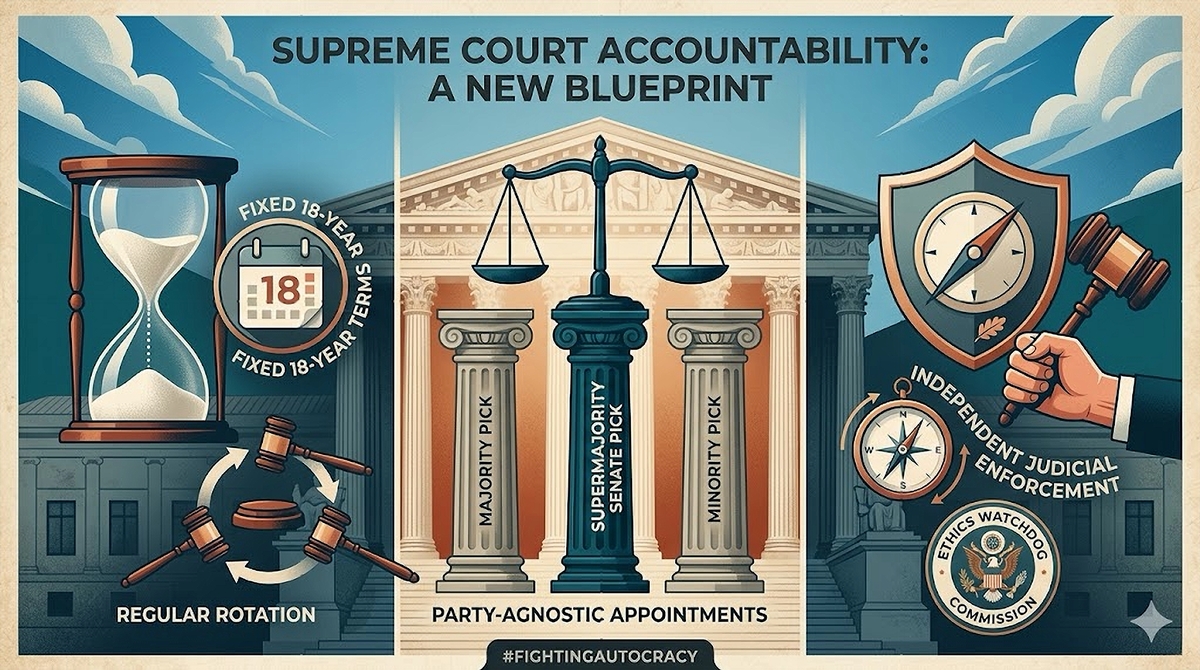
If we’re going to embark on the monumental task of amending the U.S. Constitution, we might as well go bigger, think deeper, and build a framework that structurally immunizes the Court from hyper-partisanship. So, here’s an idea. We can create a comprehensive, self-executing constitutional amendment built on three pillars: structural rotation, party-agnostic appointments, and independent judicial enforcement.
Pillar I: An 18-Year Regular Rotation
Rather than the chaotic, unpredictable vacancies left by lifetime appointments, where the death or strategic retirement of a single justice triggers a national political meltdown, the Court would transition to fixed, staggered 18-year terms.
Under this model, one justice would rotate off the active bench every two years. An 18-year tenure is long enough to preserve judicial independence and shield justices from short-term political pressures, ensuring they aren’t writing opinions with an eye on their next corporate career. And, it guarantees that the Court regularly refreshes and reflects the evolving constitutional consensus of the nation.
Pillar II: Judicial Accountability Through Balanced Appointments
Past proposals maintain the traditional model of presidential nomination and Senate confirmation, which has devolved into a toxic game of political brinkmanship. To fix this, the amendment would strip partisan labels from the process and codify a balanced, “3-3-3” Senate-driven appointment structure.
- Three seats would be appointed directly by the Senate Majority Leader.
- Three seats would be appointed directly by the Senate Minority Leader.
- Three seats would require a two-thirds supermajority vote of the full Senate, forcing lawmakers to agree on consensus, moderate jurists.
By tying the appointments to the structural roles of “Majority” and “Minority” rather than explicitly naming Democrats or Republicans, the Constitution remains adaptable to future political realignments.
Crucially, this system would include an anti-gridlock failsafe. If the Senate failed to confirm a consensus justice within 90 days of a vacancy, the appointment power would automatically default to a council composed of the Chief Judges of the 13 U.S. Circuit Courts of Appeals. By removing Washington politicians from the equation entirely if they refuse to do their jobs, we ensure the Court is never permanently crippled by partisan obstruction.
Pillar III: Enforcing True Supreme Court Accountability
The Supreme Court’s current ethical framework is a paradox: the justices are bound by an ethics code, but they are entirely self-policing. The ultimate constitutional remedy, impeachment, is so hyper-partisan and high a bar that it offers no real accountability.
This amendment would establish an independent Supreme Court Ethics Commission, staffed by retired federal judges and legal ethics experts serving non-renewable terms. This body would possess full subpoena power to investigate financial disclosures, travel, and conflicts of interest.
To keep politics out of judicial discipline, enforcement would not belong to Congress. Minor infractions would result in mandatory fines administered by the commission. For major violations, the commission would refer findings to a rotating Judicial Review Tribunal composed of active federal appeals court judges. This tribunal of peers would hold the constitutional authority to suspend or permanently remove a Supreme Court justice for failing to maintain “good behavior.”
The Path Forward
Critics will argue that a constitutional amendment of this scale is a fantasy in a divided America. And it might be. But the fight for Supreme Court accountability through structural reform is uniquely unifying; recent polling shows that vast majorities of Democrats, Independents, and Republicans alike support ending lifetime appointments.
We have to move past reactive, piecemeal bills that serve as mere political signaling. By enshrining structured terms, a gridlock-proof appointment process, and independent judicial oversight into the Constitution, we can strip the toxic partisan stakes from every Supreme Court vacancy. It’s time to return the nation’s highest court to its rightful place: a respected, independent defender of the rule of law.