
Estimated reading time: 6 minutes
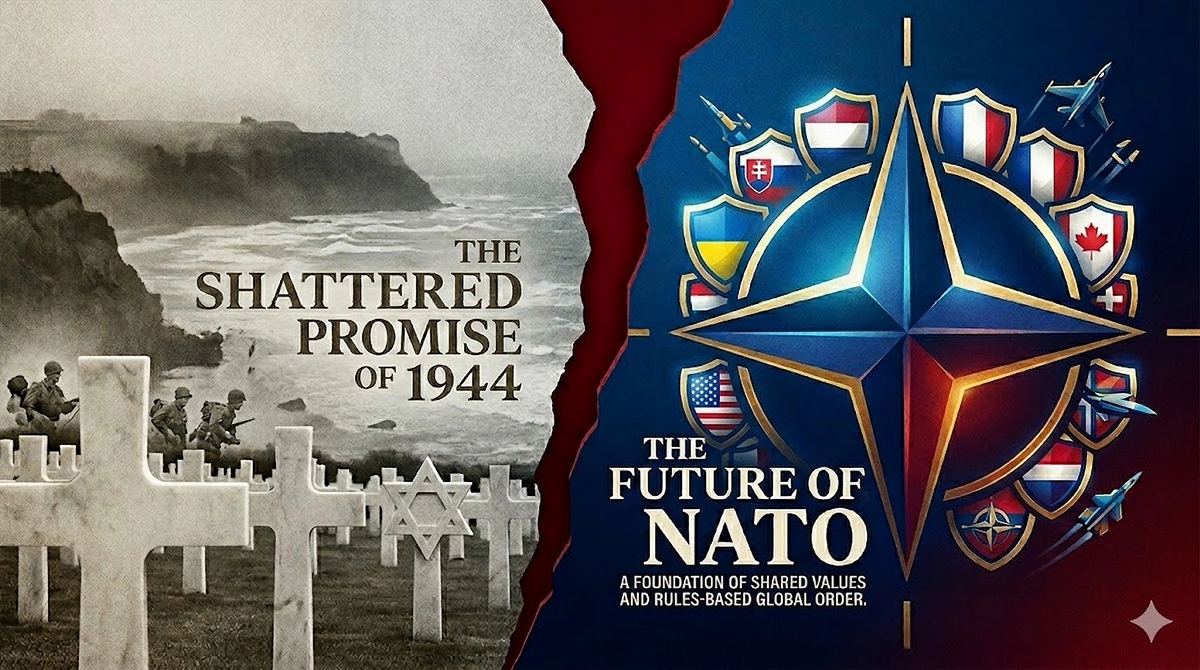
When the first wave of Allied troops hit the gray sand of Omaha Beach on June 6, 1944, they were carrying more than weapons; they were carrying the foundation of a rules-based global order. The thousands of men crammed into those landing craft didn’t risk everything for a cynical calculation. They knew exactly why they were stepping onto those beaches: they were fighting to safeguard the values of liberty and self-determination that defined the American way of life. They faced a wall of lead that ultimately claimed 2,501 American lives across the Normandy coast that day, leaving the shallows choked with the bodies of men who sacrificed their futures so that freedom might survive. They fought, they bled, and they died for a revolutionary concept: that the security of the free world is indivisible, and that brutal autocrats can’t be permitted to rewrite global borders through sheer, unprovoked force.
The triumph of D-Day did more than liberate a continent; it drew a line in the sand against the ancient, lawless doctrine that a tyrant can dictate the borders of a continent. Codified a few years later through the creation of NATO, this victory established a simple, sacred premise: an attack on one is an attack on all, a principle formally enshrined in Article 5 of the North Atlantic Treaty. For over seven decades, this shield of collective defense has functioned as the ultimate deterrent, preventing another catastrophic global conflict by transforming former enemies into vital democratic allies.
Yet today, that hard-won mutual defense alliance faces an existential threat from within, driven by a political movement led by Donald Trump that openly disdains the very future of NATO and the concept of mutual defense.
Trump’s venom directed at NATO can’t be explained away as a conventional debate over defense metrics or European burden-sharing. It’s the logical extension of an authoritarian mindset that is fundamentally opposed to democratic alliances. To Trump, the world is not a community of shared values, but a lawless arena of crude extortion, where security is a commodity and loyalty is extorted, not earned. By publicly threatening to abandon historic allies and suggesting he would encourage adversaries to do “whatever the hell they want” to nations behind on their payments, he isn’t just talking about budgets. He is signaling a return to a volatile, pre-1944 world, an era where the strong dominated the weak, democratic commitments were entirely disposable, and global security was subordinated to the whims of a single strongman.
Authoritarianism and the Future of NATO
Trump’s hostility is the inevitable byproduct of an authoritarian worldview. Authoritarianism, by its very definition, can’t tolerate institutional guardrails, shared governance, or rules that apply equally to the powerful and the weak. Here, at home, this manifests as an open disdain for the checks and balances of a constitutional republic. An independent judiciary, a free press, and legislative oversight are all treated as obstacles to be dismantled or subverted in pursuit of absolute executive power.
It’s entirely logical, then, that a leader who views domestic democratic institutions as nuisances will view international democratic institutions the exact same way.
NATO is fundamentally a treaty-based, consensus-driven alliance of equals. When evaluating the future of NATO, it becomes clear that it will continue to operate on laws, mutual trust, and a shared commitment to democratic values, the precise antithesis of how a strongman wields power. Authoritarians do not understand partnerships; they understand spheres of influence. They do not negotiate; they dictate. For someone like Trump, a mutual defense alliance is not a sacred bond forged in the crucible of a global war against fascism; it is a mercenary arrangement where security is bought and sold. However, when international relations are reduced to a series of crude, transactional shakedowns, global security is no longer anchored by stable treaties, but subordinated entirely to the self-interest of a strongman who demands absolute fealty over treaty obligations.
The Price of Trading Collective Defense for Transactional Favors
The consequences of this worldview are matters of life, death, and global stability. The post-war order has endured precisely because deterrence relies on absolute certainty. When a U.S. president introduces contingency into Article 5, treating mutual defense as a negotiable favor, the entire architecture of deterrence crumbles. This is the inevitable result of a foreign policy driven by personal grievance. When European allies rightly refused to join an unprovoked war with Iran, Trump didn’t see sovereign partners exercising strategic wisdom, he saw defiance. By berating the alliance as a ‘paper tiger’ and threatening a total American withdrawal over a conflict entirely outside NATO’s scope, Trump proved it views our most critical security guarantees as a tool for leverage rather than an ironclad commitment to collective survival.
Without a credible American guarantee, the world defaults instantly to a pre-1944 reality. We don’t have to guess what that world looks like; history has already written the script, proving that a retreat into isolationism is the first step toward expanding executive power and unchecked global aggression. It’s a world of unchecked expansionism, where borders are fluid and determined entirely by military might. By signaling to revisionist autocrats that American protection is conditional and negotiable, a transactional foreign policy actively sabotages the future of NATO and invites global aggression. It rewinds the map of Europe to its darkest eras, telling vulnerable nations that their sovereignty lasts only as long as a neighbor’s restraint.
The peace secured by the Atlantic alliance was never a charitable handout to Europe. It was a pragmatic shield that kept a fractured world from sliding back into a total war that would inevitably drag America right back into the crossfire.
The Broken Promise
To really understand what’s at stake, look away from Trump’s political rallies. Look toward those lonely rows of white marble crosses and Stars of David at the American Cemetery in Normandy. The men buried there crossed an ocean to build a better, safer world for all of us. They made a promise, with their lives, that the United States would stand as an unshakeable bulwark against tyranny, anchored in a free and cooperative coalition of nations.
Walking away from NATO, or treating our ironclad commitments as negotiable favors, is a profound betrayal of that sacrifice.
Trump’s autocratic mindset at home naturally seeks to smash the democratic order abroad, replacing a legacy of shared sacrifice with the whims of one man. But international stability is not a bargaining chip to be traded away for political leverage, and the future of NATO cannot be discarded when it demands effort. As we honor the anniversary of D-Day, we must recognize that defending the Atlantic alliance is not an act of charity to our neighbors. It’s the ultimate fulfillment of our debt to the generation that saved the West. To abandon the promise of 1944 is to invite the very darkness they died to defeat.