
Estimated reading time: 4 minutes
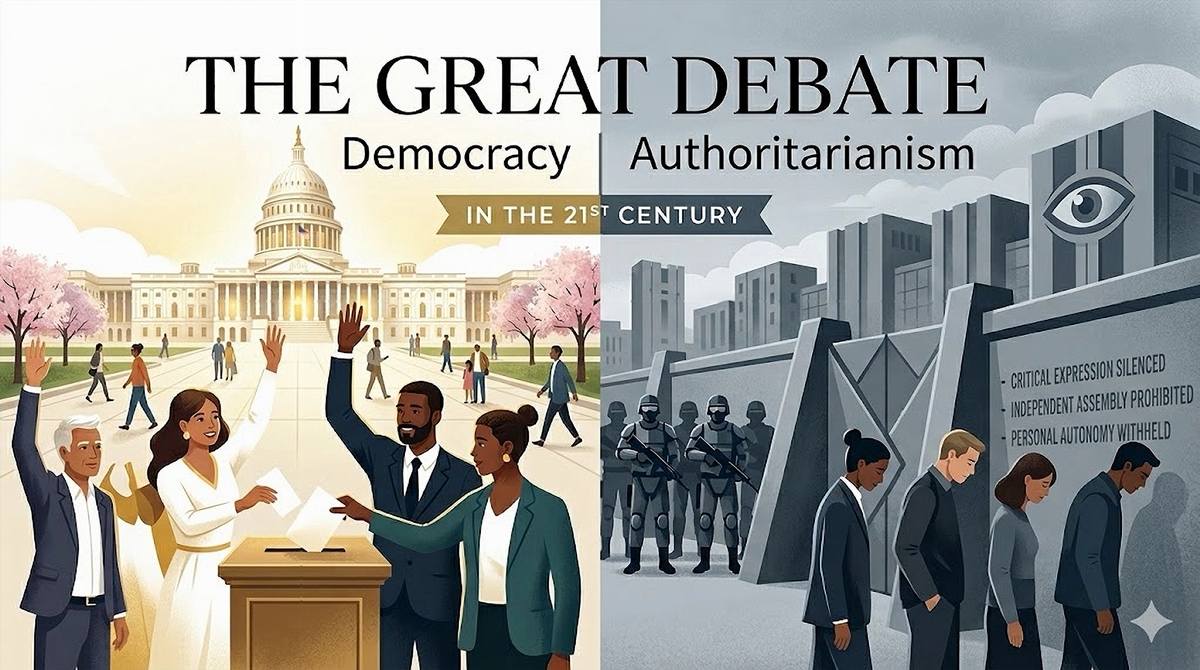
The defining struggle of our era is being played out in the quiet erosion of institutions, the weaponization of digital algorithms, and a fundamental clash of ideas. At the heart of this geopolitical shift is the modern democracy vs authoritarianism debate. The core question of the 21st century remains: Can democratic societies adapt and survive, or will the future belong to the modern autocratic state?
Historical Context of Democracy and Authoritarianism
To understand where we are, we have to look at how these opposing systems evolved. At its core, democracy is a system of government where power is vested in the people, exercised through free elections, protected by the rule of law, and sustained by robust civil liberties. Conversely, authoritarianism concentrates power in the hands of a central leader or a small elite, severely limiting political diversity and institutional checks and balances.
For decades following the collapse of the Berlin Wall, the global trajectory seemed clear. The late 20th century was defined by the “Third Wave” of democratization, a historical shift that saw military dictatorships and communist regimes collapse across Europe, Latin America, and Asia. It was an era of profound optimism, where Western-style liberal democracy was widely viewed as the inevitable end point for modern states.
However, the dawn of the 21st century disrupted this narrative. Key events, ranging from the economic shock of the 2008 financial crisis to the rapid rise of state-led capitalism in China, began to reshape the landscape. Authoritarianism didn’t fade away. Instead, it modernized, learning to exploit the globalized economy and digital infrastructure to present itself as a stable, efficient alternative to democratic gridlock.
Current Examples: The Democracy vs Authoritarianism Debate
Today, we’re witnessing a phenomenon that political scientists call “democratic backsliding.” Rather than collapsing through sudden military coups, modern democracies are frequently dismantled from within. Elected leaders, once in power, gradually subvert the very rules that placed them there. Here, at home, we’re seeing that through the dangerous trend of Expanding Executive Power.
Globally, the shifts toward authoritarianism are stark:
- The Erosion of Checks and Balances: In countries like Hungary and Turkey, we see prominent case studies of leaders systematically packing the courts, rewriting electoral laws, and stifling independent media to consolidate power under the guise of legal legitimacy.
- The Impact on Citizen’s Rights: As these regimes tighten their grip, the first casualties are civil liberties. Independent journalists face harassment, political opposition is marginalized, and minority groups are frequently targeted as scapegoats to solidify majority support.
These shifts have triggered a massive realignment in global politics. Autocratic regimes are no longer isolated actors; they’re increasingly forming alliances to shield one another from international sanctions, exporting surveillance technologies, and aggressively challenging the traditional rules-based international order.
Public Sentiment and Civic Engagement
Despite these systemic pressures, the ultimate battleground remains the public mindset. In many established democracies, long-standing economic inequality, political polarization, and gridlock have fueled a dangerous apathy, leaving some segments of the population disillusioned with traditional democratic institutions.
Yet, this apathy has met fierce resistance. Around the world, the threat of tyranny has reawakened civic consciousness. From mass anti-corruption protests to localized voter mobilization efforts, ordinary citizens are recognizing that democracy is not a self-sustaining machine.
Civic movements are actively stepping into the breach to defend democratic values. Recent surveys and public opinion studies consistently show that while faith in political parties may be low, the underlying desire for personal freedom, government accountability, and human rights remains remarkably resilient globally. People still want a voice; the challenge lies in channeling that desire into sustained political participation rather than temporary outrage, ensuring citizens remain the deciding factor in the global democracy vs authoritarianism debate.
Solutions to Counter Global Democratic Backsliding
If current trends continue, the future of democratic institutions will likely be fragmented. We may see a world divided into distinct ideological spheres: a shrinking core of resilient liberal democracies, an aggressive bloc of digital autocracies, and a volatile outer ring of hybrid regimes fluctuating between the two.
To prevent an authoritarian-leaning world, we have to move beyond defensive rhetoric and implement structural solutions:
- Strengthening Democratic Institutions: Democracies must proactively protect judicial independence, reform electoral systems to ensure fairness, and root out institutional corruption to restore public trust.
- Combating Disinformation: The media landscape and technological sphere have to be reformed. This means enacting smart regulations to hold social media platforms accountable for foreign influence operations, particularly when dealing with the psychological fallout of disinformation in the digital age. We must implement these safeguards to protect institutional integrity and support independent journalists.
- Fostering Civic Education: Long-term resilience requires reinvesting in civic education. People need to be equipped with the media literacy skills necessary to navigate a polluted information ecosystem and understand the vital mechanics of the democratic process.
Democracy’s greatest strength has always been its capacity for self-correction. Unlike authoritarianism, which relies on rigid control and the suppression of criticism, democratic systems thrive on openness, adaptability, and the courage of their citizens. The 21st-century debate is far from decided, but the outcome will depend entirely on our willingness to fight for the institutions that protect our freedom.