
Estimated reading time: 5 minutes
Understanding Democratic Strengths: The Pre-Trump Era
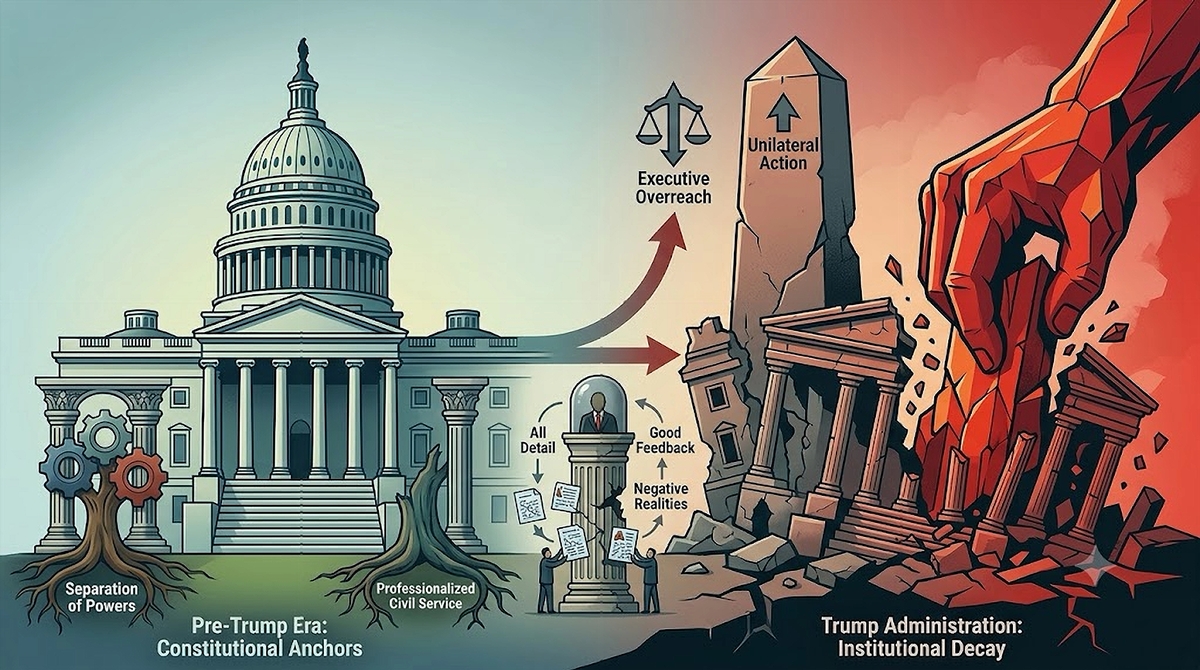
Before the systemic shocks of the current administration, the American democratic model served as the primary global case study for institutional resilience. International allies and adversaries alike viewed the American system as an anchor of predictability, capable of absorbing internal political friction without destabilizing its global commitments. However, the systematic hollowing-out of these traditional structures has laid bare critical Trump authoritarian vulnerabilities that threaten the bedrock of our constitutional balance. This strength was historically derived from a foundational framework built upon the separation of powers, a professionalized civil service, and absolute institutional accountability, demonstrated by the peaceful transition of power and steady continuity of governance regardless of shifts in the ruling party.
Historically, American stability relied on deliberate friction between co-equal branches. The system assumed the executive would seek to expand its power, relying on a robust Congress and an independent judiciary to check that overreach. This constitutional machinery proved its worth during critical flashpoints: a defiant Congress enacted the War Powers Resolution of 1973 to claw back unilateral military authority, and a unanimous Supreme Court forced the surrender of the Watergate tapes, proving the presidency is subordinate to the law.
Key pillars defining this era included:
- A Non-Partisan Bureaucracy: Federal agencies were staffed by career civil servants whose institutional knowledge acted as a stabilizing anchor against political whim.
- The Rule of Law as an Economic Arbiter: When the government lost in federal court, the executive complied. This predictability allowed domestic and foreign markets to thrive, knowing regulations and property rights were dictated by stable statutory law rather than the arbitrary whims of a chief executive.
- Insulated Justice: While aberrations occurred, most notably under Nixon, the systemic backlash actually codified the modern standard. For decades, the Department of Justice operated under strict norms of operational independence, ensuring prosecutors could not be converted into a personal tool of presidential vengeance.
Examining Authoritarian Weaknesses Under Trump
The second term of the administration offers a vivid window into specific authoritarian weaknesses under Trump within a Western context. Authoritarianism is inherently brittle because it substitutes institutional trust with systemic repression, a lack of transparency, and unchecked power.
Rather than projecting strength, Trump’s aggressive consolidation of power has demonstrated profound systemic weakness, replacing institutional stability with personal loyalty:
- The Deconstruction of Public Safety: Personnel purges have hollowed out vital institutional memory across critical agencies, with immediate, dangerous consequences for the public. In FEMA and the CDC, these purges have fractured baseline readiness and crippled responses to natural disasters and medical emergencies. Within the military leadership, unprecedented purges, including forcing out the Chairman of the Joint Chiefs of Staff, the Chief of Naval Operations, and the Army Chief of Staff, have fractured the apolitical cohesion of the armed forces during active global conflict. Meanwhile, ideological purges at the DOJ have shifted focus away from hunting domestic security threats and organized crime in favor of political compliance.
- The Information Silo and Executive Blunders: In an environment where dissent is treated as disloyalty, executive staff routinely filter out negative realities to pass along only “good” feedback. This psychological silo destroys inclusive decision-making, resulting in impulsive, unilateral blunders. This dynamic was vividly exposed by the execution of the 2026 Iran War. Ordered with zero congressional consultation and by rolling over seasoned military commanders, the massive strikes were driven more by backchannel, personal understandings between Trump and Prime Minister Netanyahu than by rigorous Pentagon strategy. The resulting conflict instantly shattered regional stability, disrupted global energy corridors, and demonstrated the devastating global cost of an administration operating in an information vacuum.
- Erosion of Legal Accountability: Trump’s overt willingness to ignore lower federal court orders and weaponize the justice system to prosecute political opponents has fractured the predictability of the rule of law, exposing the brittle nature of a state governed by decree rather than law.
Contrasts in Governance: Trump Consolidation of Power vs. Democracy
The operational divergence between these two eras highlights entirely different philosophies of power:
| Governance Attribute | Traditional Democratic Framework | The Trump Administration Approach |
| Policy Formulation | Deliberative & Inclusive: Forged through legislative debate, public scrutiny, and statutory compliance. | Top-Down & Centralized: Executed via hyper-accelerated Executive Orders (over 200 in 2025 alone) bypassing Congress. |
| Error Correction | High: Flawed initiatives are exposed by independent watchdogs, audited by the GAO, and corrected. | Low: Admitting failure is treated as weakness; independent inspectors general are routinely dismantled or fired. |
| Institutional Integrity | Insulated: Independent regulatory agencies (FCC, FTC, financial regulators) serve the public interest free from partisan interference. | Subjugated: These same bodies are stripped of autonomy via loyalist appointments; regulatory power is weaponized to reward allies and punish adversaries. |
This shift is most visible in the systematic hollowing-out of the alphabet agencies. Where the FTC and FCC once stood as neutral referees protecting consumers, they have been converted into political cudgels used to threaten the licenses of critical media networks and launch retaliatory investigations against non-compliant corporations.
Redefining Institutional Vulnerability: The Reality of Brittle Authoritarianism
To look toward the future, we have to confront a stark, new lesson: Our democratic institutions were far more fragile than we realized because they relied on compliance, not compliance mechanisms.
The true vulnerability exposed under Trump is that the “guardrails” of American democracy were largely held together by voluntary adherence to unwritten norms. When an executive branch possesses the explicit willingness to bypass Congress’s power of the purse, ignore court orders, and leverage the military for domestic political displays, traditional statutory text proves to be a weak barrier against raw political will.
A shift toward authoritarianism does not require a military coup; it happens through the rapid, legalistic hollowing-out of a state from within. Moving forward, the defense of democratic values can’t simply rely on hoping leaders respect the spirit of the law. It requires binding statutory protections that strip the executive of its ability to weaponize the civil service and a fierce reassertion of congressional authority. Ultimately, the defining challenge we face today is our collective responsibility to legally and socially contest every single inch of executive overreach.