
Estimated reading time: 5 minutes
The Prerequisite of an Informed Public: Resisting Strategic Omission
Knowledge is power. This is especially true when we go to the polls. An autocratically leaning administration, like the one Donald Trump tirelessly works to expand, relies heavily on strategic omission to keep voters in the dark. They fear an informed electorate because they understand where real power lies: with the people.
If you pay close attention to what you read, to what you hear, you’ll begin to see a deliberate effort to control what we know. Press briefings are no longer open to all; media outlets that genuflect to Trump are given preference, reporting his statements with a distinct pro-administration bias as part of a broader strategy of suppressing free press and information. Defense Secretary Pete Hegseth seek to restrict media access at the Pentagon, while administration officials testifying before Congress routinely refuse to answer questions or spin their responses. And when a president lies so freely, it raises an inevitable question: are others in his administration just as comfortable deceiving the public? They mislead us on a daily basis.
We live in a constitutional republic. As such, we aren’t meant to be a passive audience that simply accepts whatever the Trump administration tells us – a standard that applies to any president. We are stakeholders and decision-makers. Our entire democratic system relies on a fundamental prerequisite: that “We the People” have access to accurate, unvarnished information about the actions, decisions, and outcomes of our government. Without that baseline, true accountability is impossible. We can’t hold anyone accountable for their actions or behavior.
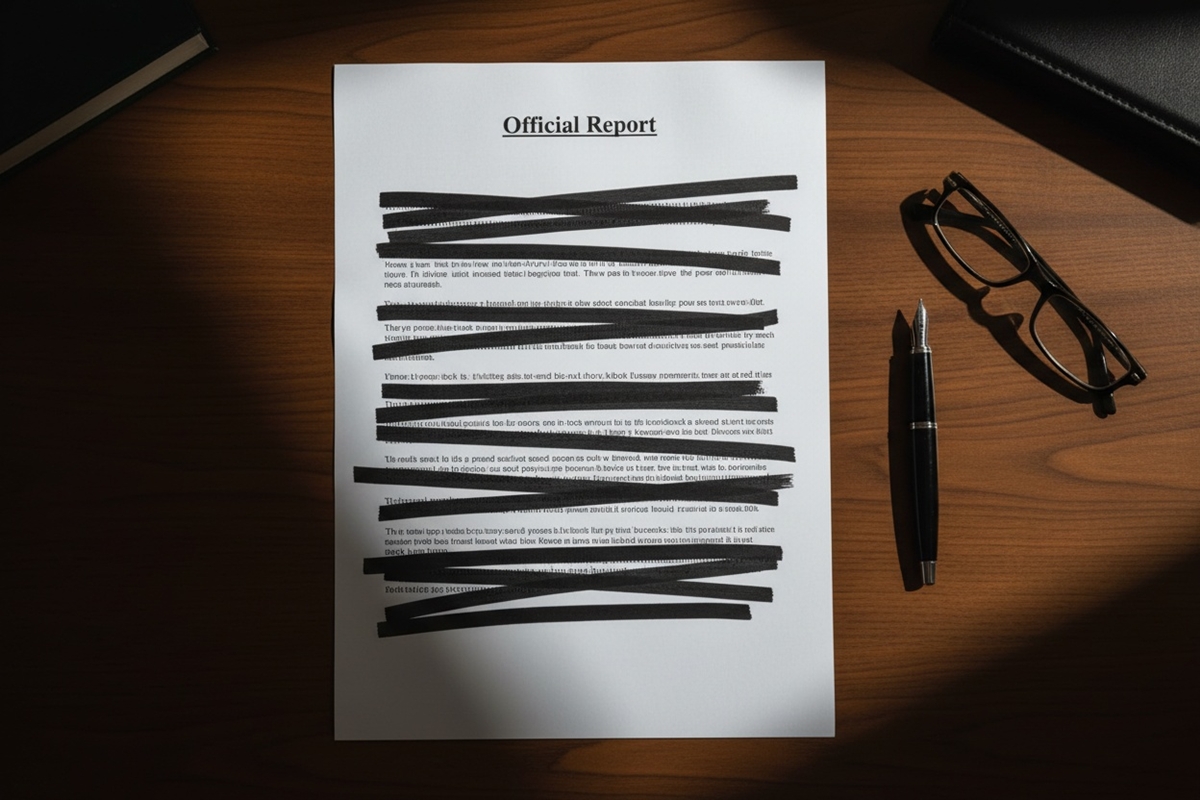
While flashy, outrageous lies tend to dominate our news cycles, insulting as they are, a far more effective strategy is at work behind the scenes. Strategic omission, selective silence, and the deliberate reframing of harsh realities serve to strip us of our seat at the table. When Trump or members of his administration withhold critical facts, they are actively attempting to remove us from the governing process altogether. You could say it’s a form of information-based voter suppression: you can’t make informed decisions at the ballot box if you’re systematically denied the knowledge required to make them.
The Mechanism: How Strategic Omission Strips Power
While outright falsehoods by Trump and others in his administration invite loud debate and immediate fact-checking, quiet omission works silently in the background. A false statement presents a visible target that journalists, political opponents, and us ordinary people can challenge and refute. Strategic omission, however, creates a vacuum. By choosing to ignore an inconvenient truth, a flawed initiative, or a worsening crisis, the administration prevents the discussion from taking place at all. How do you debate an issue that’s been erased from the official record?
Trump has a history of inflating minor successes while ignoring failures, effectively constructing an artificial reality. Emerging economic problems, international friction with allies, or rising consumer burdens aren’t treated as policy challenges requiring our input, but as non-events, or worse, converted into phantom victories.
The damage inflicted by this tactic is profound. When the public is fed a distorted view of the facts, several things happen simultaneously. First, policy advocacy Is paralyzed. As citizens, we can’t lobby our representatives or demand action be taken to correct problems we’re told don’t exist. Second, public oversight is systematically sanitized. Key metrics that measure the effectiveness of Trump’s decisions are hidden or altered, making objective evaluation nearly impossible. And third, democratic choice is compromised. A vote cast without understanding the true consequences of past policies is no longer a fully informed choice.
By withholding the facts necessary to judge performance, Donald Trump effectively declares that our role in decision-making is an inconvenience to be managed rather than a constitutional duty to be honored.
Reclaiming the Stakeholder Role
During his speech, Churchill made his most famous comment on democracy saying, “Many forms of Government have been tried, and will be tried in this world of sin and woe. No one pretends that democracy is perfect or all-wise. Indeed, it has been said that democracy is the worst form of Government except for all those other forms that have been tried from time to time…”
Preserving American democracy from Trump’s efforts to undermine it is a daily battle, but it’s one worth fighting. Democracy can be eroded in many ways. We’ve seen it in his attacks on the media and the judiciary, the preposterous attacks on American citizens by federal agencies and his attempts to undermine the ballot box. It also slides away when we accept that we’re no longer entitled to the truth. When Trump treats information as a commodity to be hoarded, manipulated, or selectively erased, he’s making a clear statement about our role in governance: we don’t have one.
Recognizing Trump’s omissions and spin for what they truly are, tactics to strip power from the American people, is the first step in countering them. Demanding transparency from a president shouldn’t be a partisan exercise. It’s a fundamental assertion of civic rights.
When Trump’s statements clash with what you see on your streets, in your community, and in your household budget, trust what you live over what you’re told. A government that fears an informed public is a government that understands where real power ultimately resides. It’s time for us to stop accepting a false reality and reclaim our rightful place as the primary stakeholders of this republic.
Leave a Reply