
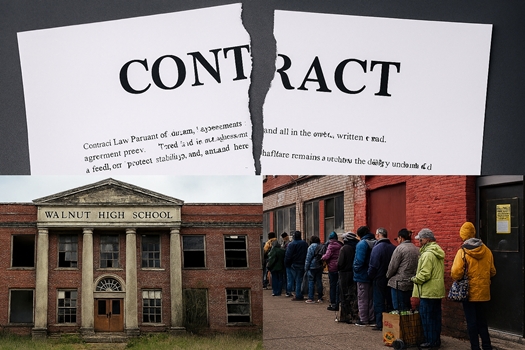
Our government isn’t an ornament of power, or a stage for political theater. It is a contract, forged between the American people and their leaders, built on the promise of protection and the pursuit of a better life. We consent to be governed not out of love for authority, but out of necessity: to secure safety, justice, and opportunity. In return, our government is bound to safeguard the dignity of its citizens, to ensure that no family goes hungry, cold, homeless, or untreated in sickness. This contract isn’t abstract; it’s lived daily in the schools that educate our children, the hospitals that heal our sick, the jobs that sustain our families, and the communities that give us belonging. When government honors this contract, people thrive. When it breaks faith, people suffer and the legitimacy of government itself comes into question.
In rural America, families face a slow erosion of opportunity and dignity. Once‑thriving towns built on farming, mining, and manufacturing now struggle to survive as jobs vanish, schools crumble, hospitals close, and communities shrink. Broadband remains scarce, cutting families off from modern economic and educational opportunities. Wages are low, housing is often inadequate, and kids leave in search of futures elsewhere, hollowing out the very heart of these communities. For those who remain, the struggle isn’t only economic but cultural, a gnawing sense of abandonment, as if the nation has forgotten them. They see their traditions dismissed, their labor undervalued, and their voices drowned out by distant elites. What was once a proud way of life has been reduced to survival, leaving families with the bitter feeling that they are invisible in the country they helped build.
In American cities, families live with a daily grind of insecurity. Housing costs soar, schools falter, wages stagnate, and healthcare remains out of reach. Parents work tirelessly yet still struggle to provide stability. Beyond these material hardships lies a deeper wound: the feeling of being forgotten. Urban families watch luxury condos rise downtown while their own neighborhoods decay. They feel neglected by government, anxious for their children’s safety, and doubtful that opportunity will ever arrive.
At a time when rural families watch their towns hollow out and urban families struggle under the weight of unaffordable housing, failing schools, and inaccessible healthcare, the Trump administration has chosen to look elsewhere. Instead of addressing the erosion of opportunity and dignity across America, it has focused its energy on mass deportations, stripping food and healthcare from the vulnerable without remorse, and indulging in symbolic gestures like tearing down portions of the White House and altering its historic interior. While families across every part of the country cry out for relief, headlines are consumed with the Epstein files, military assets massed off Venezuela, tariffs that raise costs for ordinary people, and a spiraling cost of living. These choices reveal a government more concerned with spectacle and power than with the daily survival of the American people. The result is a widening gulf between the needs of the nation and the priorities of its leaders – a betrayal of the very purpose for which government exists.
We face an indifferent administration, as well as a “do‑nothing” Congress whose leadership has chosen paralysis over progress. Rather than compromise with Democrats to end a government shutdown and extend the Affordable Care Act for an interim period, a step that could have bought time to fix problems and protect millions of families, Republican leadership refused. Instead of allowing debate and votes on matters of public concern, such as the Epstein files, the House was effectively closed to avoid accountability. This is more than inaction; it is deliberate harm. By refusing to govern, Congress has left families without healthcare, workers without paychecks, and communities without hope. The very branch designed to represent the people has become a barricade against their needs, proving itself incapable of even the most basic function: to legislate in service of the nation.
The contract between government and the governed has been broken. Rural families are abandoned, urban families are neglected, and the institutions meant to protect them are consumed by theater, paralysis, and self‑interest. A government that can’t feed the hungry, house the homeless, heal the sick, or educate its children isn’t a government fulfilling its purpose. It’s a government in collapse. The time has come to demand renewal: a refocusing of power away from spectacle and toward service, away from division and toward dignity. America doesn’t need rulers; it needs leaders who remember that their first duty is not to themselves, but to the American people. Until that contract is restored, the legitimacy of our government will remain in question, and the strength of our nation will continue to erode.