
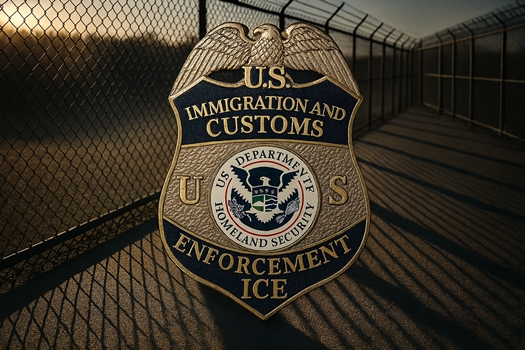
The Bush Years
ICE hasn’t really changed since it was created. The agency you see today is the same one that came into being in 2003, and it goes after its goals with the same fire it had back then. If you’re looking for a single thread to explain ICE’s behavior over the years, I think it’s this: it’s a federal agency with a nationalistic, us-versus-them worldview. It believes in absolute, uncompromising enforcement of immigration law as a matter of national security, and it will pursue that goal regardless of, and sometimes in direct opposition to, the political party in power. The internal mindset is basically, “If the law lets us do it, we should do it.” And civil immigration law gives them an enormous amount of room to do just that.
When Congress created the Department of Homeland Security in 2002, it also laid the groundwork for ICE. But while Congress built the structure, it never gave the agency a clear, unified mission. So, ICE filled that vacuum itself.
From day one, journalists, civil-rights groups, and local officials were calling ICE’s Enforcement and Removal Operations (ERO) aggressive, and in some cases, extremely so. Many of us forget that the Bush years saw some of the biggest immigration raids in modern American history. In 2006, ICE hit six Swift & Co. meatpacking plants at the same time in Colorado, Nebraska, Texas, Utah, Iowa, and Minnesota. Hundreds of agents in tactical gear stormed the plants, zip-tied workers, and shipped them off to facilities across multiple states. For days, families had no idea where their loved ones were.
Then, in 2008, ICE descended on Agriprocessors, the nation’s largest kosher meatpacking plant, in Postville, Iowa, a town of about 2,200 people. This was partly a response to the Bush administration, which wanted a big, headline-grabbing raid to send a message to employers and prove its “toughness” on immigration. It also became a test run for mass criminal prosecutions.
The operation involved 900 federal agents armed and in full riot gear. They arrested nearly 400 workers in a single day, most of whom had no criminal record beyond their immigration status. Before the raid even occurred, ICE and federal prosecutors had a plan in place for mass prosecution. They set up a temporary courtroom on a cattle fairground, where detainees were herded through a makeshift justice system and pressured into quick guilty pleas. And the plant’s executives? Not a single one was charged with an immigration crime!
During this same time period, ERO teams were also carrying out early-morning home raids and sweeps, often entering without a warrant by claiming they had “consent.” These operations didn’t just target one person; they’d arrest anyone else present who was undocumented. Civil-rights groups documented children watching their parents get taken away, people being arrested who weren’t on ICE’s list, and raids happening without a judge’s sign-off. The tactics were loud, forceful, and meant to intimidate, and they’ve defined the agency’s identity ever since.
| What “Consent” Means in Immigration Enforcement Under the Fourth Amendment, ICE can’t just enter a private home. They need one of two things: – A judicial warrant, signed by a judge. – Voluntary consent from someone inside. The thing is, ICE almost never has a judicial warrant. So, they lean heavily on “consensual entry,” a legal idea that lets them in as long as a resident appears to agree to it. |
The Obama Years
When Obama came into office, he inherited the massive enforcement machine built under Bush, but he also faced a growing political backlash against the workplace raids. He needed to find a balance between enforcement and his own push for immigration reform. To do this, his administration issued a series of “prosecutorial discretion” memos between 2011 and 2014. These memos told ICE to focus on national security threats, serious criminals, and recent border crossers, while de-prioritizing people who had been here for years, had U.S. citizen children, or had deep ties to their communities and no criminal history. It was a direct attempt to dial back ICE’s aggression.
Obama also ended the Bush-style workplace raids, shifting instead to employer audits, fines, and paperwork-based enforcement. This was a major move to de-escalate ICE’s public-facing tactics. He also tried to restrain the agency through DACA and the attempted DAPA program, which were designed to protect millions of long-term residents, get them out of the deportation pipeline, and force ICE to focus on more serious threats.
But ICE pushed back. Hard. Multiple investigations showed that agents were still arresting people who fell outside the priority categories. Field offices were either ignoring or actively undermining the new guidance. The ICE union publicly attacked Obama and his DHS leadership, and officers complained that the administration was “handcuffing” them.
DHS leadership clashed with ICE over and over. Secretaries Janet Napolitano and Jeh Johnson scolded field offices, reissued guidance to try to force compliance, and attempted to centralize enforcement decisions to hold people accountable. It didn’t work.
So, what happened? The administration talked about priorities, sent out memos, and tried to steer the ship, but they almost never imposed real disciplinary consequences on the officers or field leaders who ignored them. They could have reassigned resistant field office directors, removed supervisors, or launched internal investigations, but they rarely did. Instead, DHS just kept issuing new memos, which ICE field offices often treated as mere suggestions.
If DHS had actually disciplined officers, the union would have screamed “retaliation,” “political interference,” and “handcuffing law enforcement.” Picking that fight would have burned an enormous amount of political capital. In the end, the administration chose to manage around ICE instead of taking it head-on.
Observations
ICE’s story under Bush and Obama points to a deeper truth: once you create an enforcement agency, give it sweeping legal authority, and then fail to clearly define and enforce its limits, it will define its own mission and defend it fiercely. Bush furthered the development of ICE’s culture through spectacular, fear‑driven operations; Obama tried to tame that culture with policy tweaks and memos, but largely backed away from confronting it directly. The result was an agency that felt itself empowered and entitled to operate according to its own worldview, one rooted in exclusion, maximal force, and a belief that elected leaders who disagreed with it were obstacles.
ICE did not simply enforce the law; it enforced its interpretation of the law. And by the time two presidents had passed through the Oval Office, the agency had learned a dangerous lesson: an enforcement culture left unchallenged does not fade. It waits for a president who shares it.
That moment arrived in 2017. What Bush had built and Obama had failed to restrain; Trump would embrace outright. And for the first time, ICE’s worldview was given political validation, rhetorical oxygen, and a mandate to act on its most hard‑edged instincts.
Author’s Note
ICE is constantly in the news and on our minds. They’re a scary bunch that quite literally mirror gestapo tactics in Nazi Germany. It is an agency whose tactics and posture have long raised serious questions about power, accountability, and the way a federal institution can develop its own worldview over time. I wrote this piece because I wanted answers.
Where did ICE’s nationalistic, exclusionary philosophy come from?
Was it baked into the agency from the start, or did it grow out of the Bush administration’s approach to immigration and national security?
Who truly drives ICE’s direction? Its political leadership or its unionized enforcement ranks?
How aggressive were ICE’s operations in its early years, and have those tactics evolved or intensified over time?
And during the Obama years, did ICE’s worldview shift at all? If not, how did the agency respond to a president whose priorities often clashed with its own?
These questions led me into the history that became Part One. The next set, the ones about ICE’s relationship with Trump, and what happens when an agency’s internal philosophy finally aligns with the president in power, will be the focus of Part Two.
Related Essays