
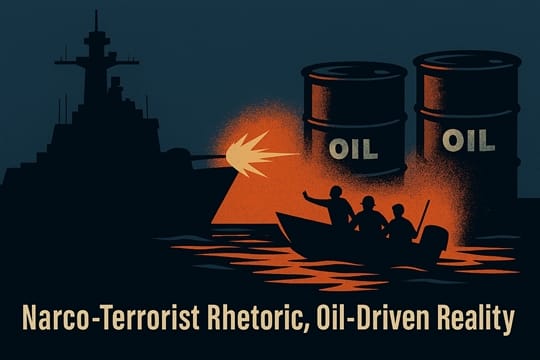
Until recently, drug interdiction was the domain of law enforcement and the Coast Guard. Smugglers were treated as criminals, afforded due process. That changed on September 2, when the U.S. military carried out a strike on a boat off Venezuela’s coast, killing eleven passengers. In remarks and on his social media platform, Trump declared: “The U.S. military conducted a strike against a vessel carrying drugs today, killing 11 narco‑terrorists.” Yet no verifiable proof has ever been presented to support the claim. Multiple outlets, including FOX and CBS, described the vessel as a “drug boat” or “alleged Venezuelan drug boat,” but none offered evidence that narcotics were present. If the occupants were only alleged narco‑terrorists aboard an alleged drug boat, then their deaths amount to what I described in a September 8 post as an extrajudicial killing, carried out without evidence, oversight, or due process. Whether there was one strike or two is irrelevant. It was still an extrajudicial killing. It was murder.
The Rationale for Committing Extrajudicial Killings
Trump’s stated justification rests on several pillars. He declared that drug cartels and their affiliates are terrorist organizations, reclassifying smugglers as unlawful combatants and framing operations as part of an armed conflict rather than law enforcement. The White House and Defense Secretary Pete Hegseth further argued that these actions are lawful acts of self‑defense under the law of armed conflict, even though the boats were in international waters and posed no direct threat to U.S. forces. Trump also claimed the vessels were “drug boats” carrying narcotics from Venezuela, insisting that killing traffickers was necessary to prevent lethal substances from reaching American communities. Finally, in late September 2025, he sent a confidential notice to Congress declaring that the United States was in an “armed conflict” with drug cartels, providing legal cover for continued military strikes.
The Burden Placed on U.S. Troops
Trump’s agenda has resulted in more than 80 extrajudicial deaths, without acceptable legal justification or proof that those killed were drug smugglers. This lack of clarity places a heavy burden on U.S. service members, who are ordered to carry out lethal missions under ambiguous rules of engagement. Troops have been left to execute strikes without transparent evidence of criminal activity, exposing them to accusations of war crimes, if that even applies, and eroding the moral legitimacy of their actions. Instead of operating within a clear legal framework, they have been forced into a gray zone where accountability is uncertain, international law is contested, and the risk of personal and institutional liability looms large. In effect, the administration’s rhetoric has shifted responsibility from Trump, Hegseth and Admiral Bradley downward, leaving soldiers to bear the ethical and legal consequences of decisions made without proof.
It’s Never Been About Drugs
Trump insists the strikes are about stopping drugs, but the absence of evidence that the targeted boats carried narcotics undermines that claim. If drugs were the true target, Colombia, the world’s primary source of cocaine, would be the logical focus. His reclassification of smugglers as “narco‑terrorists” reveals a calculated effort to shift the legal framework from law enforcement to armed conflict, granting the president extraordinary latitude to use military force. Obviously, this move isn’t about interdiction; it’s about consolidating executive power, bypassing judicial oversight, and testing the boundaries of war powers. At the same time, the language of “drug boats” and “narco‑terrorists” serves a powerful messaging function: it simplifies a complex legal and moral issue into a visceral narrative of protecting American families from poison, rallying public support through fear and toughness. Finally, by tying the strikes to Venezuela’s Tren de Aragua gang, the administration positions itself as confronting not just crime but hostile foreign influence, using cartel violence as a proxy for broader strategic pressure.
Trump’s End Game
I believe it’s safe to say that the war on “narco‑terrorists” is a mirage; a very transparent mirage at best. Beneath it lies Trump’s deeper goal of gaining influence or control over Venezuela’s vast oil reserves – the largest in the world, estimated at over 303 billion barrels, surpassing even Saudi Arabia. The sheer scale of these reserves makes Venezuela a strategic flashpoint in global energy politics. For Nicolás Maduro, oil revenues are the backbone of his regime, providing hard currency and geopolitical leverage through ties with Russia, China, and Iran. For Washington, weakening that lifeline has long been a way to destabilize Venezuela, and Trump’s aggressive posture, including naval strikes framed as anti‑drug operations, fits into this broader strategy of squeezing Maduro’s economic survival.
By portraying Venezuelan gangs like Tren de Aragua as “narco‑terrorists” and labeling vessels as “drug boats,” the administration creates a vivid narrative of protecting American families from poison. The “drug war” framing allows Trump to bypass international law and congressional oversight, enabling him to pursue the real objective, securing influence or control over the world’s largest oil reserves.
Sacrificed Lives and Soldiers in the Crossfire
The Venezuelan boat occupants in the ongoing strikes have been killed to secure access to billions of barrels of oil, sacrificed as symbols in a war that doesn’t actually exist outside of rhetoric. Their deaths were justified with unproven claims of narcotics and terrorism, transforming civilians into expendable pawns. At the same time, U.S. troops have been thrust into the crossfire of this policy, ordered to carry out missions that may violate both domestic and international law. Soldiers are forced to act without evidence, risking accusations of war crimes and bearing the moral injury of killing under dubious orders. In this way, both the passengers and the troops are casualties of a strategy that prioritizes political goals and geopolitical ambition over truth and legality. The administration’s mirage of a drug war has sacrificed lives at sea and placed American service members in untenable positions, leaving them to shoulder the ethical and legal consequences of decisions made far above their rank.