
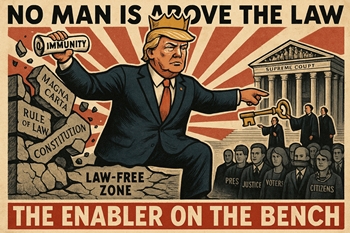
The 2024 Presidential Immunity Ruling by the Supreme Court remains the defining catalyst for the erosion of the American principle that the King is not the Law. From the Magna Carta to the downfall of Richard Nixon, the accountability of the executive was the primary guardrail of freedom. But in its landmark 2024 ruling in Trump v. United States, the Supreme Court shattered this principle. By granting a President absolute immunity for “official acts,” the Court transitioned from a neutral arbiter to an active enabler of authoritarianism, a marked divergence from the founders’ vision.
A License for Corruption: The Impact of the Presidential Immunity Ruling
The Court’s decision created what Justice Sonia Sotomayor called a “law-free zone” around the Oval Office. Shielding a President from criminal prosecution transforms the office into a vehicle for personal gain. If a President uses the levers of government to enrich themselves or their family, they no longer fear the deterrent of a courtroom. By removing the threat of legal consequences, the Court invited a future where the presidency is not a public trust, but a private enterprise.
The Weaponization of Federal Power Under the Immunity Ruling
Perhaps the most chilling aspect of this ‘new normal’ created by the Presidential Immunity Ruling is the green light it gives for the corruption of federal agencies. Under this ruling:
- The DOJ is now a Personal Law Firm: The Court held that a President’s discussions with the Justice Department are absolutely immune. This empowers Trump to direct the DOJ to investigate rivals or protect cronies while remaining untouchable.
- Targeting the “Enemies Within”: Freed from the fear of prosecution, Trump can use Homeland Security and the military to silence dissent. He can also target universities or prosecute media outlets and their journalists. When a President believes he’s outside the law, every critic becomes a potential target by a weaponized state.
Bypassing the People’s Representatives
By removing the threat of legal consequences, the Presidential Immunity Ruling effectively allows a President to usurp Congressional prerogatives without fear of judicial review. This consolidation of authority is part of a broader trend toward expanding executive power that threatens the very core of our democratic institutions. In our system, the Founders intended Congress to be a co-equal branch. The Founders designed it that way to counter abuses of power. However, the immunity ruling effectively allows a President to usurp Congressional prerogatives as well. A President might bypass oversight or ignore the ‘power of the purse’ through ‘official’ actions. If the public cannot question these acts in court, our checks and balances have ceased to function. And in an environment where a Congressional majority lacks the backbone to exercise its own punitive measures, the Supreme Court has now removed the only remaining obstacle to a “would-be King”, itself.
The Guardrail is Gone
“No man is above the law” shouldn’t be just a catchphrase; it’s the structural integrity of a republic. When the Supreme Court rules that courts cannot question a President’s motives or prosecute their official crimes, it’s putting a crown on the head of the executive. This decision represents a significant leap in the ongoing process of eroding judicial independence in favor of partisan protection.
Right now, we’re watching authoritarians build their system brick by brick, with the highest court in the land providing the legal cover. We must reckon with the consequences of the Presidential Immunity Ruling. We must restore the principle that the law applies to everyone. This includes everyone from the poorest American to the man in the Oval Office. Otherwise, we must admit the guardrails are gone.
Trump v. United States
The specific legal mechanics of the Presidential Immunity Ruling create three primary dangers for the future of the Republic:
| Absolute Immunity for DOJ Interactions: The Court ruled that Trump’s alleged attempts to use the DOJ to subvert the 2020 election were absolutely immune. This effectively shields him and any future President who uses the department for political ends. |
| Motive is Irrelevant: The ruling states that courts cannot inquire into a President’s motives when determining if an act is official. This is the “enabler” clause; it means even if a President acts out of pure malice or corruption, the act remains shielded. |
| Evidence Suppression: The Court also ruled that “official acts” cannot even be used as evidence to prove a crime in “unofficial” actions, making it nearly impossible to prosecute a President for any complex scheme. |
Reversing the Presidential Immunity Ruling: The Path to Restoration
If the judiciary has effectively abdicated its role as a check on executive overreach, the burden falls back to the people and their representatives to mend the fence. A meaningful legislative or constitutional “fix” would need to address three specific vulnerabilities created by the Court:
- The “No Man Is Above the Law” Amendment: A formal Constitutional Amendment is the only foolproof way to override a Supreme Court interpretation. Such an amendment would explicitly state that the President is subject to federal criminal law for all actions. This would apply regardless of whether they are deemed ‘official’. It would effectively codify that the presidency is a workplace, not a sanctuary.
- The “Evidence Restoration Act”: Congress must pass legislation clarifying that ‘official acts’ can serve as evidence. This would apply specifically to criminal proceedings. By stripping away the “evidentiary privilege” created by the Court, prosecutors could once again use a President’s own words and meetings to prove corrupt intent.
- DOJ Independence Reform: To prevent the “weaponization” of federal agencies, Congress must move to insulate the Department of Justice from direct White House interference. This would involve new statutory requirements for the Attorney General. They would be required to report any presidential attempts to influence investigations directly to Congress.
The Final Argument: A Republic, If We Can Keep It
The Supreme Court has handed us a “King” in all but name. By providing legal cover for self-enrichment, the subversion of Congress, and the persecution of “enemies,” they have invited the very authoritarianism the Founders feared. We are at a crossroads: we can either accept a presidency that exists outside the law, or we can do the hard work of rebuilding the guardrails.
The phrase “no man is above the law” must be more than a slogan on a protest sign; it must be the ironclad rule of our country. If we allow the presidency to remain a “law-free zone,” we aren’t just losing a legal battle. We’re losing the Republic itself.