
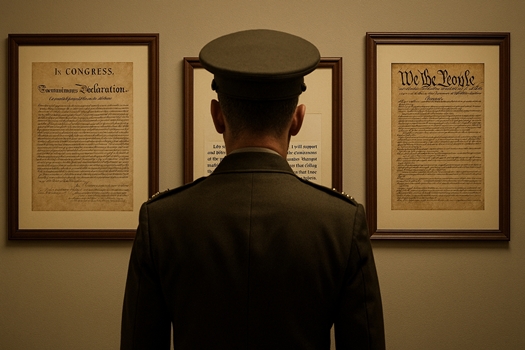
Something deeply wrong is taking root inside the American military. It’s not about new jets or high-tech weapons. It’s a shift in thinking, a quiet betrayal of a core principle: the duty to stand up to an unlawful order. Instead, a convenient new doctrine is emerging: just retire and look away.
This isn’t some bureaucratic tweak. It cuts to the very heart of what it means to serve a country under the rule of law. And it forces us to ask a deeply uncomfortable question: When did staying silent become the honorable thing to do?
Recent reporting has pulled back the curtain on this. The advice coming from the Joint Chiefs’ own top lawyer is stunning: if a commander receives an order they believe is illegal, they shouldn’t refuse it. They shouldn’t report it. They should just… request retirement. Not a resignation in protest – that would be too political. Not a principled stand – that might create waves. Just a quiet exit.
This is being sold as a prudent way to avoid conflict. It’s not. It’s an abdication of duty.
Think about it. We don’t tell a police officer who witnesses a crime to just “put in for retirement.” We don’t tell a teacher who sees a child being abused to “quietly find a new job.” We tell them—we tell everyone – if you see something, say something.
Yet, when the stakes involve the awesome and lethal power of the United States military, the message is suddenly the opposite: if you see something wrong, just walk away and hope nobody notices you’re gone.
This flies in the face of generations of military tradition. As far as I know, the rule has always been simple and absolute: you obey lawful orders, and you disobey unlawful ones. This isn’t just a suggestion in an ethics manual; it’s the bedrock that prevents soldiers from becoming the private instruments of power, and ensures they remain guardians of the Constitution. Trading that sacred duty for a quiet pension hollows out the very soul of military professionalism.
Legal experts are already sounding the alarm, pointing out that this advice fundamentally misunderstands the law. The correct, and long-taught, response to an illegal order is to refuse it, try to get it rescinded, and report it up the chain. That’s not some radical idea; it’s the standard.
But the real problem isn’t just legal, it’s cultural.
What kind of culture does this create? It teaches officers that the path of least resistance is the path to success. It tells everyone down the line that your career matters more than your conscience. And it slowly builds a leadership class where the only people left are the ones who were willing to look the other way.
This isn’t civilian control of the military; it’s civilian manipulation. True civilian control depends on leaders getting honest, unfiltered feedback – even when it’s hard to hear. It requires officers with the backbone to say “No, sir” when the law requires it, not a line of careerists quietly slipping out the back when things get ethically complicated.
Of course, there are times when an officer might resign over a policy disagreement. But that’s not what this is. This is a blanket instruction: if an order is illegal, don’t fight it, just leave. That’s not courage; that’s outsourcing your conscience.
Worse, this “retire quietly” advice is even more insidious than it looks. Retiring doesn’t set an officer free to speak their mind. They are still bound by the Uniform Code of Military Justice, which can be used to silence them on matters that would be protected speech for any other citizen. So, this strategy doesn’t just get a dissenting voice out of the room – it gags them on their way out the door. A system like this isn’t protecting the institution; it’s protecting the people giving the questionable orders.
And this isn’t some abstract ethical debate. Right now, the U.S. is involved in lethal operations in the Caribbean and Pacific that are raising serious legal and ethical questions. We have lawmakers saying Pentagon officials admit they don’t always know who they’re targeting. We have human rights groups pointing out that suspected traffickers are civilians who should be arrested, not killed. And the Trump administration hasn’t shown public proof that these targets posed an imminent threat.
These are life-and-death decisions being made in our name. In this kind of environment, the last thing we need is a military culture that encourages silence.
A military that can’t say, “This is wrong,” can’t be trusted when the stakes are at their highest. An officer corps that learns to walk away from wrongdoing is one that has forgotten what honor really means.
The truth is simple: silence isn’t neutrality. It’s endorsement.
We expect our soldiers to die for what’s right. The least we can do is demand that their leaders have the courage to speak up for it. The American people deserve a military that follows the law, not just in its actions, but in its conscience. And the men and women in uniform deserve better than to be told that integrity is less important than convenience.
That old saying, “If you see something, say something,” shouldn’t stop at the Pentagon’s door.