
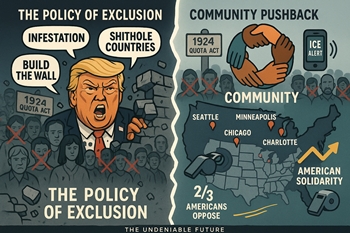
For decades, politicians have framed our debate over immigration as a tug-of-war between economic necessity and national security. We often discuss labor shortages, border tech, and increasingly larger visa backlogs. However, to view the Trump immigration policy through these sterile lenses is to ignore the foundational logic that animates it. Consequently, as we connect the dots between the rhetoric, the groups targeted, and the historical precedents, it becomes clear that this isn’t just about border management; it is a project of racial preservation.
The Language of Dehumanization
Policy doesn’t exist in a vacuum. Since the 2016 campaign, the rhetoric surrounding Trump immigration policy has shifted from legalistic concerns to visceral, racialized attacks. By branding Mexican migrants as “rapists” and referring to non-white nations as “shithole countries,” Trump signaled that the “problem” was not the act of crossing the border, but the specific origins of those crossing it.
His use of words like “infest” and “invasion” serves a specific purpose: it strips individuals of their humanity, reclassifying human beings as biological threats to a “pure” American society. This language mirrors the “Great Replacement” theory, a staple of white supremacist ideology, which posits that white populations are being systematically replaced by non-white immigrants.
The Racial Intent of the Trump Immigration Policy
The racial intent is most visible in which policies have been prioritized and which dismantled. While the administration claims to support “legal immigration,” its actions tell a different story:
- The Pursuit of Whiteness: Trump’s expressed desire for more immigrants from countries like Norway, while simultaneously decimating the refugee resettlement program and ending Temporary Protected Status (TPS) for hundreds of thousands from Haiti, El Salvador, and African nations, reveals a clear demographic preference.
- Dismantling Progress: Efforts to end birthright citizenship and restrict legal paths for skilled workers from the Global South represent a direct assault on the 14th Amendment and the 1965 Immigration Act – both of which were hard-won victories for racial equity.
- The “Invasion” Pretext: Executive orders invoking national emergency declarations to militarize the border and conduct mass deportations rely on “invasion” rhetoric that has historically fueled violence against Black and Brown communities.
Trump Immigration Policy as a Modern Racial Bias
This agenda is not a new phenomenon; it is a revival of the 1924 National Origins Quota Act, which sought to “preserve the ideal of U.S. homogeneity.” This shift represents a significant change in U.S. immigration under Trump, moving away from a balance of compassion toward a more rigid ideological framework. Just as that era’s leaders believed “racial considerations were too grave to be brushed aside,” the current administration views the changing fabric of the nation as a cultural threat rather than an economic asset.
The Neighborhood Shield
While the Trump immigration policy attempts to engineer a more homogenous America through brutal enforcement, it has encountered a force it did not calculate: the American neighbor. The rhetoric of “invasion” and “infestation” was designed to isolate immigrant communities, but in practice, it has galvanized a massive, multi-racial pushback. From the Pacific Northwest to the Deep South, Americans are no longer waiting for legislative fixes; they are building human infrastructure to protect their own.
The Rise of the Rapid Response
In cities like Minneapolis and Chicago, the response to “Operation Metro Surge” has been nothing short of a grassroots mobilization. In the Twin Cities, where the administration specifically targeted the Somali community, over 30,000 residents have been trained as legal monitors. These “ICE Watch” networks represent a sophisticated evolution of community safety:
- Whistleblower Networks: In communities across the country, residents have distributed thousands of whistles to be used as audible alarms when federal agents enter a neighborhood.
- The Digital Shield: In Seattle and Chicago, activists use encrypted Signal groups and hotlines to track unmarked ICE vehicles in real-time, allowing families to retreat to safety before agents even exit their cars.
- Sanctuary Schools: In Minneapolis alone, over 1,000 parents have formed “Sanctuary School Teams” across 40 public schools, physically escorting children to ensure they are not snatched during the morning drop-off.
- Singing Resistance: Originating in Minneapolis, the movement has spread nationally, bringing together people of all ages to sing messages of love, courage, and resistance, often directed at ICE agents, urging them to “join us on the side of humanity.”
Furthermore, these creative acts of Trump immigration policy pushback are more than just local protests; they are part of a national trend toward active communal defense. Consequently, this shift from passive disagreement to physical proximity has fundamentally altered the political landscape, making it harder for federal enforcement to operate in secret.
From Policy to Proximity
This resistance is not merely a political statement; it is a moral refusal to allow dehumanization to take root locally. When federal agents shot and killed Renee Good and Alex Pretti in Minneapolis, the reaction was not just grief. It was a seismic realignment. Polls now show a historic shift, with nearly two-thirds of Americans believing federal immigration enforcement has gone too far. Even in states with deep-red leadership, the aggression of the “Metro Surge” has backfired.
Democratic governors in Maryland and New Mexico recently signed laws banning local police from cooperating with ICE, effectively cutting off the oxygen to the administration’s mass-deportation machine.
Conclusion: A Nation Redefined
The Trump immigration policy may be rooted in a vision of racial exclusion, but its implementation has inadvertently birthed a new American identity. By treating immigration as a biological threat to be “purged,” Trump forced every American to choose: do they side with the agents in tactical gear, or with the neighbor they see at the grocery store?
The data is clear. While the policy seeks to narrow the definition of “American,” the response from Minneapolis, Chicago, Seattle, Charlotte and hundreds of other communities has expanded it. Through “Know Your Rights” cards, neighborhood patrols, and whistle-blown warnings, a new “Underground Railroad” of mutual aid has emerged.
Ultimately, this policy has failed its primary objective. It sought to create a culture of fear that would drive “undesirables” into the shadows. Instead, it has brought them into the light of community protection.
If Trump’s goal was racial engineering, the American people have responded with a masterclass in solidarity, proving that the “pure” America the policy seeks to preserve is an artifact of the past, while the diverse, defiant America in the streets is the undeniable future.