
Estimated reading time: 5 minutes
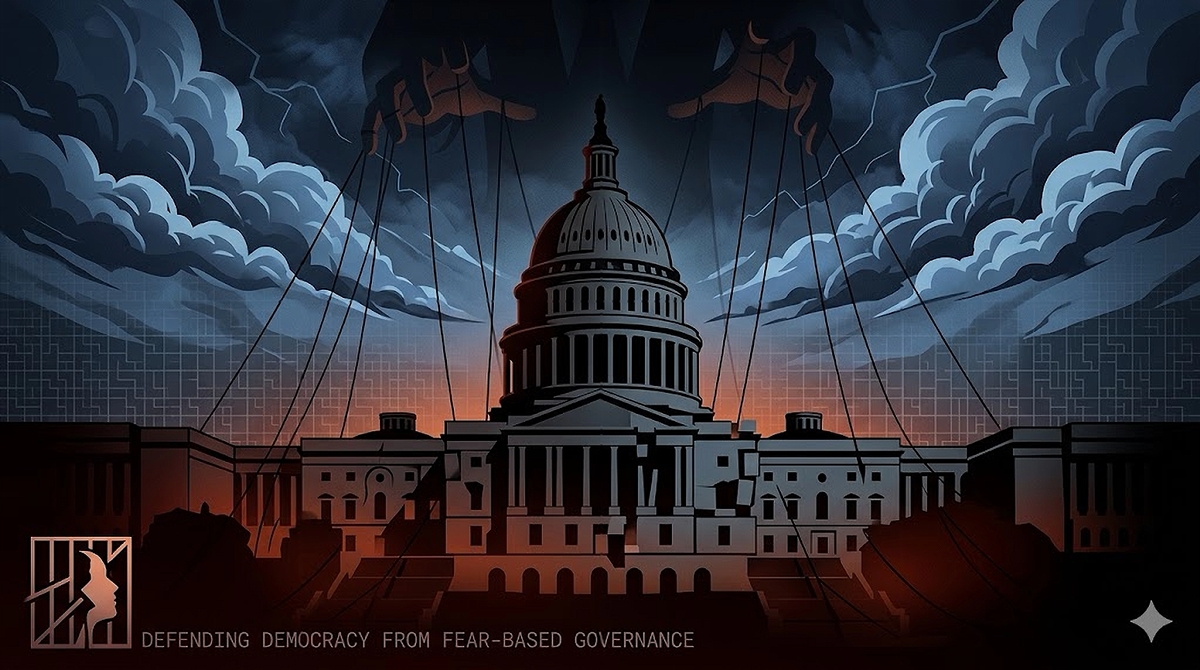
A democracy’s strength isn’t measured by its borders or its military. It’s measured by the psychological stability of its people, their trust in institutions, their confidence in the rule of law, and their belief that society is fundamentally fair. When leaders begin to weaponize anxiety, division, and fear, those foundations start to erode. Authoritarianism works primarily through psychological manipulation. It uses fear to hollow out democratic safeguards from within. Under Donald Trump, these tactics have evolved from campaign rhetoric into a formal blueprint for running the country.
Understanding Authoritarian Governance Under Trump
Authoritarianism centralizes power, weakens checks and balances, and elevates personal loyalty over institutional expertise. Illiberal regimes follow a familiar pattern: convince the public that existing systems are too weak or corrupt to protect them, then present a single leader as the only source of order and safety.
Trump’s model of fear-based governance fits what political scientists call a personalized autocracy. It draws heavily on system justification theory. Put simply: when people are exposed to prolonged, manufactured chaos, their survival instincts kick in. They become far more willing to trade their democratic freedoms for the illusion of safety offered by a rigid, powerful leader. By casting the civil service as a hostile “deep state” and portraying democratic institutions as fundamentally broken, Trump offers himself as the sole psychological anchor. Loyalty to him becomes synonymous with national survival.
Fear-Based Governance as Trump’s Authoritarian Strategy
Fear is Trump’s most powerful political tool. It bypasses rational thought and activates primal survival instincts. In a climate of panic, nuance disappears, and an “us versus them” worldview takes over, a perfect environment for manipulation.
This dynamic is visible in the aggressive executive actions of Trump’s second term. On day one, Trump issued Presidential Proclamation 10888 and Executive Order 14159. By officially labeling the southern border situation an ‘invasion,’ he reframed a complex humanitarian issue as a wartime emergency. This tapped directly into national security anxieties to justify unprecedented executive power.”
This manufactured atmosphere of existential fear paved the way for radical actions, most notably the invocation of the 1798 Alien Enemies Act in Los Angeles to bypass standard judicial immigration processing and fast-track deportations. When fear dominates the civic narrative, extreme measures, like deploying the military for domestic law enforcement and denying statutory asylum protections, are seen by supporters as necessary defenses against an existential threat rather than violations of constitutional norms.
Psychological Strategies Employed by Trump
To consolidate power and disarm opposition, Trump deploys specific psychological tactics designed to distort shared reality and ensure strict institutional compliance:
- Dehumanization and Scapegoating: By systematically branding marginalized groups, transnational gangs, and undocumented immigrants as “invaders” destroying the country from within, Trump creates a unifying external enemy. This shifts public anger away from complicated policy challenges and redirects it toward a vulnerable “Other,” lowering the psychological barrier for the public to accept harsh or unlawful state actions.
- The “Retribution” Narrative and the Civil Service Purge: Trump uses the threat of economic ruin to enforce absolute loyalty within the government. By leveraging the ‘Schedule Policy/Career’ classification (a revival of his ‘Schedule F’ plan), his administration can strip civil service protections from up to 50,000 career federal employees. Replacing an independent, merit-based workforce with political appointees turns objective public servants into an army of at-will workers forced to comply or face termination.
- Gaslighting and the Institutionalization of Grievance: Authoritarianism requires the destruction of objective reality. Trump’s administration has fundamentally reordered institutional priorities to mirror his personal grievances, evidenced by executive orders targeting “the weaponization of government” and DOJ’s creation of an “Anti-Weaponization Fund.” By systematically projecting his own tactics onto his predecessors and political opponents, Trump induces political disorientation. If we can’t trust the neutrality of the law or agree on basic facts, resistance becomes fragmented and exhausted.
The long-term effect of these strategies is the normalization of democratic erosion. Over time, constant institutional gaslighting fatigues the public, leading to cynicism and political apathy, the exact psychological environment an autocrat needs to permanently weaken opposition.
Counteracting Authoritarianism: Building Psychological Resilience
Opposing a governance model built on fear requires more than just political opposition. It demands psychological resilience. If the primary goal of Trump’s authoritarian tactics is to isolate individuals, induce anxiety, and exhaust the public into compliance, the remedy lies in active civic solidarity and intellectual self-defense.
Franklin D. Roosevelt, during a dark hour of economic and social crisis, famously reminded the nation of its truest internal enemy, declaring that “the only thing we have to fear is fear itself.”
In the context of a governance model that relies on manufactured crisis, FDR’s insight serves as a critical warning: the ultimate danger is not the political theater itself, but the paralysis and capitulation that panic induces within the electorate. Cultivating critical media literacy allows people to recognize emotional manipulation, such as the rhetoric of “invasion” and “retribution”, and strips those tactics of their psychological power by countering them with historical context and verified data.
Furthermore, we must aggressively support independent institutional guardrails, defending career civil servants facing political termination and civil society groups challenging executive overreach in federal courts.
Authoritarianism thrives when local communities are divided and distrustful of one another. By doubling down on civic education, fostering local alliances, and engaging in grassroots democratic participation, we can build a social fabric thick enough to withstand the psychological pressures of fear-based governance. Specifically, by supporting whistleblowers, funding legal defense funds for targeted civil servants, and aggressively defending independent journalism, we translate that civic solidarity into concrete protection for our democratic institutions. Securing democracy requires us to heed FDR’s warning to refuse the bait of manufactured panic and reclaim our collective agency.