
Estimated reading time: 4 minutes
The true measure of American democracy is found in the quiet, everyday exercise of constitutional rights by its citizens. Today, those rights face a subtle yet persistent erosion. Within the United States, Donald Trump’s steady expansion of executive authority and the polarization of legal norms are challenging the bedrock principles of a free society. To confront this trend, we have to understand how authoritarian impulses manifest within the American political framework and recognize why defending our fundamental civil liberties remains an urgent, non-negotiable duty.
Understanding Authoritarianism and Its Impact on Civil Liberties
In America, the slide toward authoritarianism has never begun with a sudden, dramatic collapse of the constitutional order. Instead, it has been a gradual, legalistic encroachment, a creeping consolidation of power that uses the mechanisms of power to weaken democratic guardrails from within
Historically, the United States has experienced periods where crises led to severe institutional overreach. For example, we saw these patterns during the Early Republic with the Alien and Sedition Acts, the suspension of habeas corpus during the Civil War, the Red Scare of the 20th century and the executive overreach of the Watergate era. In each instance, the centralization of executive power and the delegitimization of dissenting voices went hand in hand.
In contemporary American society, this threat has taken a sophisticated, systemic form. Rather than relying on overt authoritarian edicts, the process often weaponizes partisan gridlock, exploits deep cultural polarization, and pushes the boundaries of executive orders to bypass congressional oversight. By normalizing this reliance on executive mandates and the rhetoric of constant national emergency, foundational protections like speech, privacy, and peaceful protest are quietly being sidelined. The resulting chilling effect fundamentally erodes public trust in the neutrality of our laws, steadily shrinking the space for healthy civic dissent.
The Importance of Defending Civil Liberties
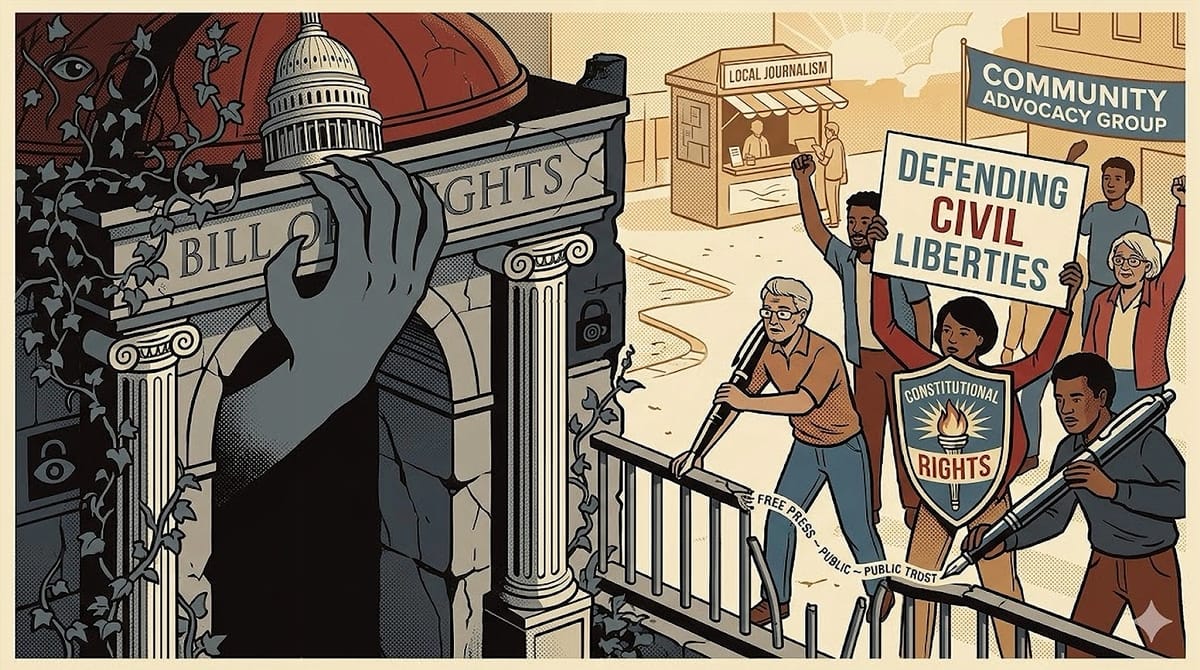
Civil liberties are the essential oxygen of American self-governance. The Bill of Rights was explicitly designed as a restrictive shield, ensuring that government power remains permanently derived from the consent of the governed and bounded by explicit individual protections.
When authoritarian tendencies rise within our political discourse, these constitutional liberties act as our primary line of defense. The current domestic landscape demonstrates that when the independence of the judiciary is questioned for political gain, or when the press is routinely attacked as an institutional enemy, the fabric of the republic begins to fracture. Defending these liberties is crucial because they safeguard the right to challenge authority, expose systemic corruption, and advocate for accountability. If we allow these foundational rights to be bargained away for short-term political victories or false promises of security, we compromise the very mechanisms required to keep a free republic intact.
Strategies for Civic Engagement and Advocacy
Countering the drift toward executive consolidation requires moving beyond passive concern and actively defending civil liberties through organized, strategic advocacy. American history has proven, over and over again, that institutional resilience is driven by collective, citizen-led action.
- Mobilize at the Local and State Level: True institutional defense begins at home. Protecting local school boards, participating in municipal government, and supporting state-level civil rights coalitions ensures that democratic norms are defended where they directly impact daily life.
- Support Independent and Local Journalism: As I’ve said many times, a vibrant press is the ultimate check on institutional overreach. Citizens can actively protect the public square by supporting local investigative reporting, resisting state-sponsored disinformation, and defending journalists from legal and political harassment.
- Engage in Strategic Legal and Digital Defense: Supporting organizations that litigate constitutional violations keeps the Bill of Rights active in federal and state courts. Furthermore, in an era of mass data collection, practicing digital hygiene and advocating for robust privacy laws protects the digital spaces where modern American civic discourse happens.
Future Implications and the Role of Citizens
If current trends toward executive overreach and the erosion of institutional checks continue unchecked, the future of American governance looks remarkably perilous. A society that grows accustomed to the marginalization of its civil liberties risks sleepwalking into a state of hollow democracy, where the rituals of voting remain, but the substantive constitutional protections that define a free populace have been drained away.
The ultimate safeguard of American freedom has always been the active responsibility of American citizens. Benjamin Franklin’s famous warning, that the Founders gave us “a republic, if you can keep it”, remains entirely true today. This demands more than occasional participation; it requires a sustained commitment to democratic norms and robust voter participation to hold leaders accountable to their constitutional oaths. Protecting civil liberties is an ongoing, multigenerational task. By exercising and defending our rights with courage and clarity today, we ensure the constitutional promise remains unbroken for the Americans of tomorrow.