
Estimated reading time: 3 minutes
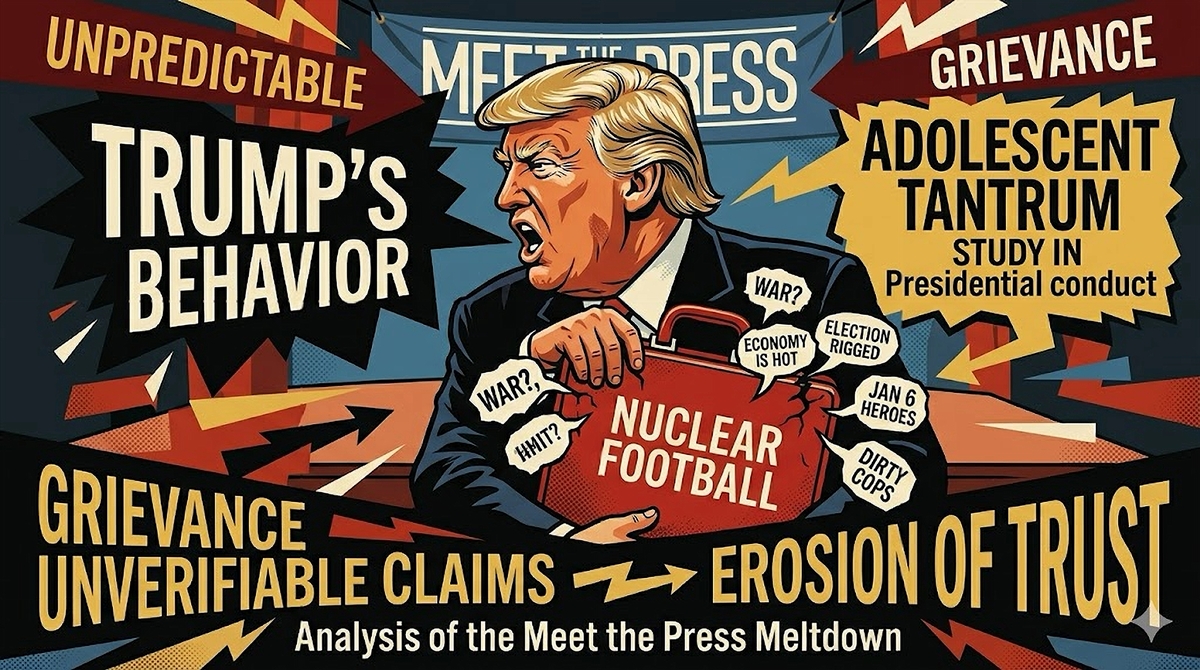
When a President of the United States speaks, the words are supposed to carry the weight of a nation. But while watching the recent Meet the Press broadcast, it is glaringly obvious that Trump’s behavior during the interview reflects an alternate reality completely detached from policy, data, or truth.
Instead, we’re being subjected to a daily torrent of inflated falsehoods, delivered by a man whose behavior mirrors that of a willful, mean-spirited adolescent.
The danger here isn’t just that the President lies, it’s the cascading erosion of trust that his lies create. If you can’t trust what the president is telling you about a military conflict or the economy, you certainly can’t believe a single word uttered by anyone else in his administration. The rot starts at the top.
The Anatomy of an Inflation: Unpacking Trump’s Behavior
Throughout the interview, Kristen Welker attempted to pin Trump down on reality, only to be met with an alternate universe built entirely on hyperbole and grievance. Take his rhetoric surrounding the ongoing conflict with Iran. In Trump’s vocabulary, a sustained military campaign is magically recast as a mere “military exercise,” an absurd semantic dodge to protect his “no new wars” campaign promise. When pressed, he pivotally redefined success not by the peace he failed to keep, but by the speed of his violence, comparing a three-month conflict to Vietnam. You can review her exact line of questioning and his responses via the NBC News Meet the Press Transcript.
Worse still are the unbelievably inflated assertions he tosses out with absolute certainty. He confidently told the American public that Iran’s navy, air force, and leadership tiers are completely “gone,” and that precisely “21 to 22 percent” of their missiles remain. These are extraordinary, entirely unverifiable claims. It’s a familiar, exhausting pattern: Trump uses hyperbole to project total control, taking credit for a “booming” economy while externalizing the spike in gas and fertilizer prices onto the very war he claims isn’t a war.
The falsehoods didn’t stop at foreign policy. From defending a staggering $1.8 billion “anti-weaponization fund” by claiming FBI agents “ushered in” January 6th rioters, to declaring without a shred of evidence that California’s vote-counting was proof of a rigged system, Trump proved once again that his narrative is built entirely on emotional persuasion, not factual reality.
Analyzing the Adolescent Tantrum in Trump’s Conduct
But the most damning part of the interview wasn’t just the substance of the lies. It was Trump’s behavior when those lies were challenged.
A mature leader handles tough journalism with composure, relying on facts or strategy to defend their record. Trump handles fact-checking the way a schoolyard bully handles getting caught in a fib. The moment Welker called him out for his falsehoods, Trump didn’t just get angry; he became visibly furious, throwing a petulant tantrum on national television.
Instead of addressing the facts, he turned viciously personal, launching insulting and abusive attacks directly at Welker. He called her “crooked or stupid” and smeared NBC as a “one-sided crooked network.” When the fact-checking became too intense for his fragile ego to bear, he did exactly what you’d expect from a cornered, hostile adolescent: he took his ball and went home. “Let’s call it quits because I’ve had enough,” he barked, abruptly ending the interview.
The Cost of a Fractured Reality
The display we witnessed on national television is the perfect distillation of the Trump presidency. It is an architecture built on dominance, unearned certainty, and endless grievance. To Trump, military escalation is rebranded as strength, legitimate media scrutiny is treated as disloyalty, and a basic request for evidence is viewed as a personal assault. In the end, this is not just an exhibition of poor temperament; it is a calculated effort to ensure that when the truth conflicts with power, power wins.