
Estimated reading time: 4 minutes
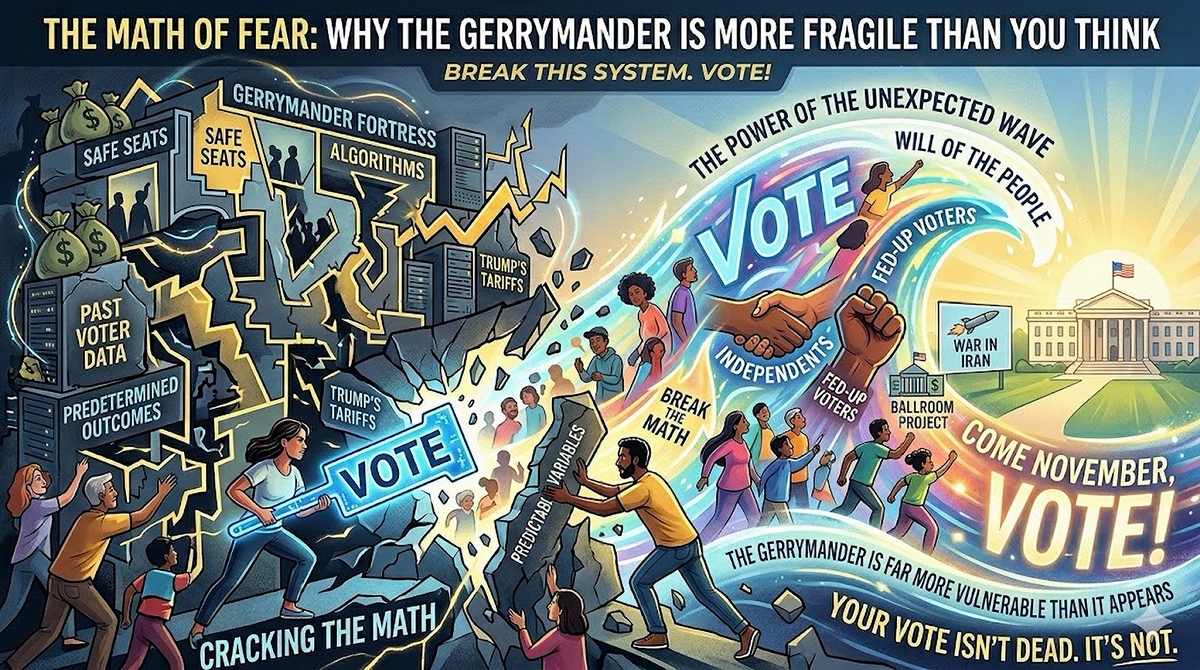
It’s easy to look at those strangely shaped voting maps, often called gerrymanders, and feel like your vote doesn’t count, but you can break the math of a gerrymander . These maps, meticulously crafted by powerful algorithms, are designed to create “safe” legislative seats, making it seem like the outcome of an election is predetermined. The goal of this manipulation isn’t just to win elections; it’s to make you believe that showing up to vote is a waste of time. It’s a psychological tactic to encourage apathy and keep you at home.
However, the truth is that these maps are far more vulnerable than they appear. The people drawing these lines are betting on past voting patterns, assuming you’ll vote exactly as you did in previous elections. They aren’t accounting for the widespread frustration that’s building among everyday people.
How We Break the Math: Cracks in the System
Consider what’s happening in our daily lives. Soaring gas and food prices are impacting families across the country. And it’s not just gas and food. Every single item you buy has become more expensive thanks to Trump’s tariffs and the cost of transportation to move those goods. Meanwhile, tax dollars are funneled into grandiose projects and foreign conflicts that feel distant and endless, while vital domestic needs go unaddressed. For example, Congressional Republicans want to allocate $1 billion to pay for Trump’s ballroom while many struggle to afford basic necessities. This disconnect is leading many, including independents and even some Republicans, to question their loyalty to a party that seems more interested in vanity projects and political chaos than truly helping their constituents.
A Voter Turnout Wave: The Power of the Unexpected
Gerrymandering operates on thin voter margins, which makes it inherently fragile. Imagine a gerrymandered map as a series of dikes built just high enough to hold back a “normal” tide of opposition voters. To maximize seats, parties spread their support thinly, aiming to win many districts by a few percentage points rather than a few districts by a landslide.
But when the tide rises unexpectedly, when a surge of frustrated voters, including disaffected Republicans and fed-up Independents, hits the polls, those dikes breach. In what’s known as a “wave” election, a map designed to secure seats can quickly become a liability. Every district that was considered a “lean” or “safe” seat can flip. We’ve seen glimmers of this in the recent past, where voter turnout defied conventional digital models.
A significant factor contributing to this fragility is the rise of “crossover” voters. These are individuals who can’t be categorized by old data points. Many feel betrayed. Past campaign promises haven’t been kept. Others are looking at issues like the erosion of the separation of church and state, threats to election integrity, continued inflation and political chaos, and are choosing to vote outside of predetermined partisan lines. When a Republican voter decides to stay home, or an Independent casts their vote for a candidate who prioritizes issues important to them, the algorithms used to draw gerrymandered maps fail. These algorithms can predict partisan loyalty, but they can’t predict a sudden outbreak of widespread frustration and anger.
Hope as a Tactical Advantage
Gerrymandering relies on predictability, the reliable voter and the reliable non-voter. But when we organize “Get Out the Vote” (GOTV) campaigns that reach into neighborhoods politicians thought they had effectively silenced, we introduce a variable they can’t control. We’re not just fighting for a political seat; we’re fighting to prove that the “will of the people” is more powerful than any gerrymandered line on a map. From successful referendums to court victories, the momentum has been shifting.
The Bottom Line
Don’t let a jagged line on a map tell you who you’re supposed to be or what your vote is worth. The maps are drawn by people who are, quite literally, afraid of you. They draw those lines because they know that in a fair fight, they lose.
So, let’s give them the fight they’re dreading. Let’s show them that while they were busy drawing lines, we were busy building a wave.
Their math only works if you stay home. So, break the math. Come November, vote!