
Estimated reading time: 3 minutes
If you can control the story through political gaslighting , you can control the people. It’s the oldest trick in the authoritarian playbook. From mid-century dictators to modern-day strongmen, repressive governments have always known that brute force only goes so far. To truly hold onto power, you have to dominate the information space. You create a simple, top-down narrative that papers over your failures and demands absolute loyalty. By attacking independent journalists, twisting economic data, and leaving out crucial facts, these regimes try to replace actual reality with a state-approved version of it.
We’ve watched this exact strategy play out right here in America. Donald Trump’s political machine has taken these classic tactics and run with them – labeling the free press the “enemy of the people,” demanding personal loyalty from public institutions, and treating the power of the state as his own personal brand. Instead of actually dealing with complex policy, his style relies on constant performance, painting opponents as existential villains, and using careful omissions to duck any real accountability.
When Political Spin Collides with Everyday Reality
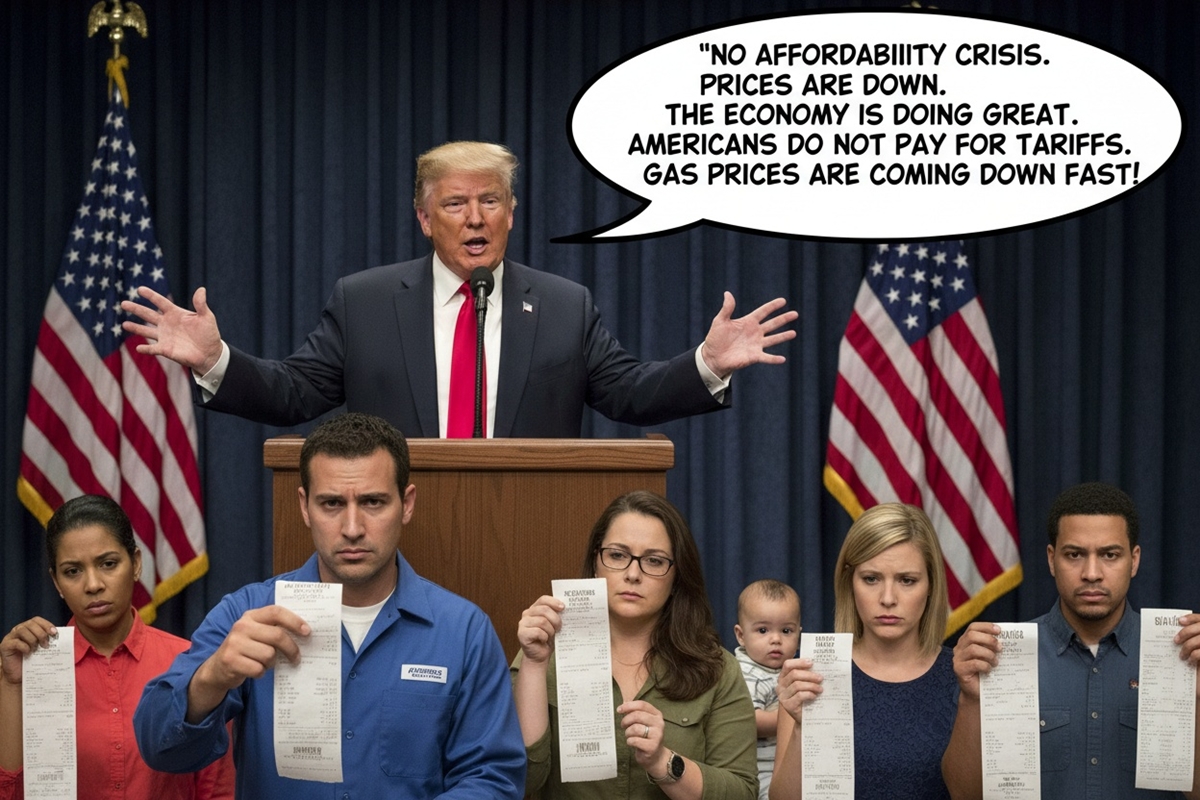
But here’s the thing: no matter how polished the press releases are, or how much they spin the numbers, top-down control eventually runs headfirst into a brick wall: the actual, day-to-day lives of ordinary people. Politicians can control what gets said in a press briefing or what flashes across a TV screen, but they can’t change the total on your grocery receipt or the price at the pump.
When the official line is that the economy is booming and everything is great, but families are staring at budgets that just don’t stretch anymore, something cracks. You don’t need a PhD in economics to see through political gaslighting when your monthly budget simply doesn’t stretch anymore. Trump and his team can leave out the facts or paint a rosy picture all they want, but our bank accounts tell a much more honest story.
What happens when a government keeps telling you to ignore what’s right in front of your face?
First, trust evaporates. When people are subjected to relentless political gaslighting, they quickly realize they’re being lied to. Some people just tune out entirely, exhausted by the endless gaslighting and figuring they’ll never get a straight answer anyway. When citizens give up and stop paying attention, the Trump administration wins.
But while lying might buy Trump some time, it doesn’t work forever. Eventually, the gap between the rhetoric and reality gets too wide to ignore, and frustration boils over. We’re already seeing that friction turn into real – world pushback – in viral memes, grassroots protests, and shifting public opinion.
The Midterm Reality Check
This clash between the official myth and real life is actually where change begins. Autocrats rely on people being too tired or defeated to think for themselves. But in a democracy, the official story eventually has to face the ultimate reality check: an election.
With the midterms coming up, this strategy of governing through spin is facing its toughest test. A press release can’t pay your mortgage, and a campaign rally won’t buy groceries. When people walk into the voting booth, they aren’t thinking about talking points – they’re thinking about their monthly budgets, the safety of their neighborhoods, and the sheer exhaustion of being told to ignore their own reality.
The big mistake of trying to run a country on lies and omissions is assuming the public will just stay quiet and play along. But that’s not who we are. American life doesn’t happen in government briefing rooms; it happens on the ground. And when real life directly contradicts the official story, it reminds us of the power we still hold, especially when we take it to the ballot box.
Leave a Reply