
Estimated reading time: 4 minutes
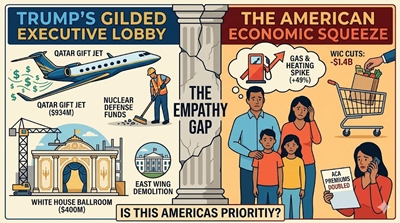
The true measure of a presidency isn’t found in its rhetoric, but in its policies. In the spring of 2026, a profound disconnect has emerged as Trump’s misplaced spending priorities favor the gilded halls of power over the personal lives of the American people. While Trump asserts that the government can no longer afford the “luxury” of basic social safety nets, he continues to find nearly bottomless reserves for executive comforts and elective conflicts. This is the story of a widening empathy gap, a fiscal philosophy where the well-being of the individual American has been traded for Trump’s personal vanity.
The Luxury of Choice: Trump’s Misplaced Spending Priorities and the Price of Legacy
At the heart of this administration is a stark contrast in lifestyle. While Trump asserts that the federal government is too cash-strapped to provide assistance for daycare or medical care, Americans are funding an unprecedented overhaul of the executive environment. The most glaring example is the $934 million diverted from critical nuclear defense programs to renovate a “free” luxury jet gifted from Qatar. This billion-dollar upgrade, coupled with millions spent to revert the Air Force One fleet to a specific blue-and-gold aesthetic, suggests a presidency focused on the trappings of power rather than the well-being of the people. This trend extends to the White House grounds as well, where a $400 million state ballroom and a $1.9 million Rose Garden renovation have taken priority over affordable housing. While the HOME Investment Partnerships Program is zeroed out, freezing repairs for the most vulnerable, Trump moves forward with a $100 million Triumphal Arch and a $40 million statue garden, prioritizing monuments of stone over the stability of American families.
Funding Global Conflict: The Executive Spending Disparity Over Domestic Wellness
Trump has frequently justified the gutting of domestic aid by claiming “we’re fighting wars,” yet these conflicts are often the result of his own escalations. By late March 2026, the war with Iran had already consumed $18 billion, with another $200 billion requested in emergency funding. Simultaneously, billions more are being poured into secondary theaters across Venezuela, Syria, and Africa. To pay for these “petty wars,” the administration is dismantling the systems that keep Americans healthy. A proposed 32% cut to the CDC and a 13% reduction for the NIH effectively surrender the fight against Alzheimer’s and heart disease to fund missiles abroad. Perhaps most telling is the $1.4 billion cut to the WIC program; by slashing fruit and vegetable benefits for breastfeeding mothers and young children, Trump is forcing the smallest victims of poverty to subsidize military readiness.
The Economic Squeeze on the American Family
As the federal safety net is retracted, the economic burden on the average household is reaching a breaking point. Under the One Big Beautiful Bill (OBBB), over $1 trillion is being siphoned away from healthcare, threatening the solvency of rural hospitals and speeding up the insolvency of the Medicare trust fund. Nutrition assistance has been slashed by $120 billion, widening the “meal gap” in nearly every U.S. County. These cuts are compounded by rising costs driven by Trump’s policies. Families are paying an average of $1,745 annually due to the cumulative effect of aggressive trade tariffs, while a sudden gas spike, born of the conflict with Iran, is costing the typical household an extra $137 per month. With ACA premiums rising as much as 114% for the previously subsidized, many families are now making the impossible choice between health insurance and basic necessities like beef and vegetables, which have surged in price by over 10%.
A Future of Abandonment
If the Fiscal Year 2027 Budget Request is enacted, the abandonment of the American people will be complete. By reducing non-defense spending to its lowest level since the Eisenhower era, Trump plans to eliminate heating assistance for 5.9 million households, freeze Section 8 housing vouchers, and functionally end career training for the nation’s youth. Trump’s refrain that states “can do it on a state basis” is a hollow promise to those in need; it is an admission that the federal government no longer considers the well-being of its citizens a priority. While Trump lives in a world of taxpayer-funded housing, food, and medical care, his policies ensure that you and your neighbors get the shaft. Ultimately, the 2027 budget reveals a clear truth: Trump is doing just fine, but he doesn’t care if you are.
Related Essays: