
Estimated reading time: 6 minutes
If you’re like most Americans, you’re feeling squeezed. Not metaphorically. Literally. Every grocery run, every utility bill, and every painful fill-up at the pump forces us to confront why Americans are paying more just to survive. You don’t need an economist, a journalist, or me for that matter, to tell you that the cost of living has climbed. You see it every time you step out the door.
And yet, we’re being told by Trump and Congressional Republicans that the economy is doing great and prices are coming down. Remember how, just two years ago, the price of eggs became a national obsession. The media covered it breathlessly. Pundits declared it proof that Joe Biden was incompetent, detached, or both. Inflation was high, and people felt it. But there were reasons for that inflation; reasons rooted in global crises, not presidential whims.
The First Inflation Wave: A Global Cost of Living Crisis
Between 2021 and early 2025, cost of living crisis was the result of a perfect storm. COVID had shattered global supply chains. Consumer spending shifted dramatically toward physical goods. Congress, under both Trump and Biden, pumped nearly $5 trillion into the economy to prevent a depression. Then Russia invaded Ukraine, triggering a global energy and food shock that pushed U.S. inflation to a 40-year high.
By the end of Biden’s term, inflation had cooled from 9.1% to around 3%. But the damage was done: prices were permanently reset about 21% higher than in 2020. We were frustrated, but the causes were clear and largely external.
Why is Inflation Rising Again? A Crisis Made in Washington
Now, in 2026, inflation is rising again, but for very different reasons. This time, the pain is homemade.
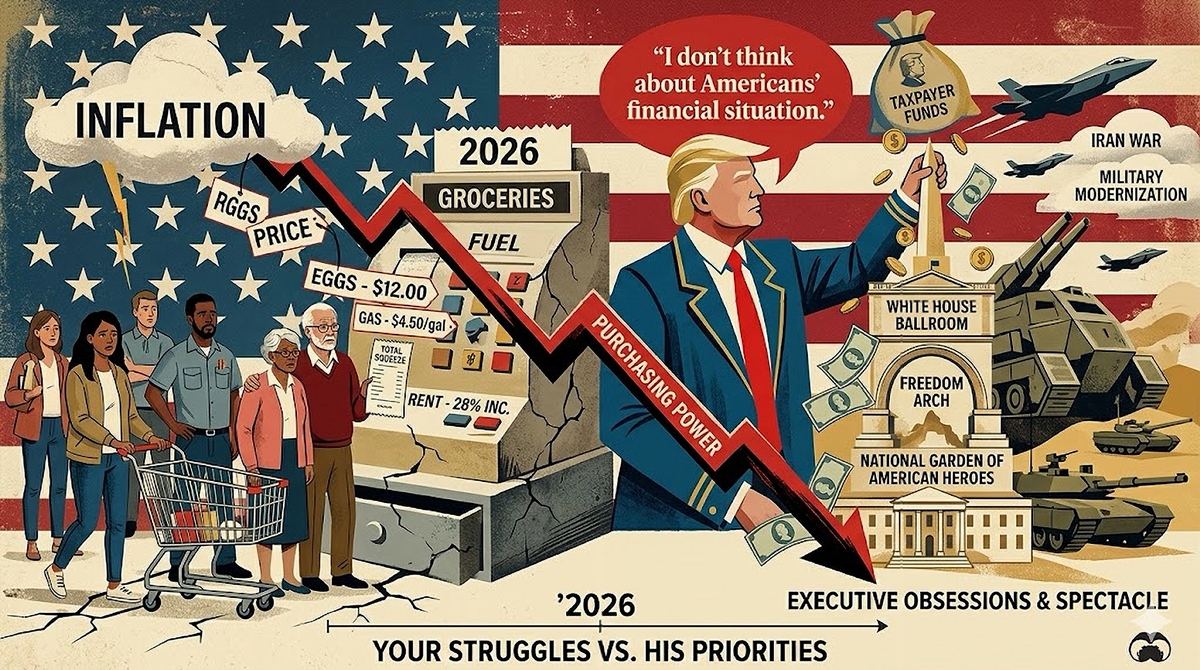
The ongoing war with Iran has sent energy prices soaring, up nearly 18% in a year, driving more than 40% of the recent inflation spike. Housing costs remain stubbornly high due to elevated mortgage rates and a chronic shortage of supply. And Trump’s broad-based tariffs have created a hidden tax on everyday goods, adding another 0.5 to 0.8 percentage points to core inflation as businesses pass costs directly on to us.
In short, Biden-era inflation was a global recovery problem. Trump-era inflation is self-inflicted.
A President Who Says the Quiet Part Out Loud
A few days ago, when asked whether Americans’ financial struggles were motivating him to pursue peace with Iran, Trump didn’t respond with empathy.
“Not even a little bit. I don’t think about Americans’ financial situation. I don’t think about anybody.”
To be honest, he insisted that he was focused on preventing Iran from obtaining a nuclear weapon. But the remark revealed something deeper, and I think more honest, about his priorities. He doesn’t think about you, your family, or the financial strain you’re under. He’s thinking about power, spectacle, and political advantage.
And what, specifically, is he obsessed with? His spending priorities provide a clear answer.
The Ledger of Misplaced Values
While Americans are rationing groceries, and postponing medical care, Donald Trump is spending millions on an unnecessary war he started and his pet vanity projects.
- The Iran War ($479B+): Beyond the $29 billion already sunk into the Iran conflict, Trump is demanding a $100 billion emergency supplemental and a $350 billion reconciliation request for “modernization”, all while proposing a massive $1.5 trillion defense budget for 2027.
- The $1 Billion Ballroom: Originally pitched as a $200 million project funded by private donors, the White House Ballroom estimate has ballooned to $400 million, with Congressional Republicans now seeking a $1 billion taxpayer appropriation to finish it.
- Vanity Monuments: Over $65 million is being diverted toward symbolic projects, including $40 million for the “National Garden of American Heroes” (funded by stripping money from the National Endowment for the Humanities) and $25 million just for the design of a new “Freedom Arch.”
- The $6.9M Reflecting Pool: Even the water isn’t immune to scrutiny; a $6.9 million no-bid contract for pool maintenance was recently awarded to a firm with reported ties to Trump’s personal business interests.
What Do We Expect When Americans Are Paying More?
I don’t think we expect a president to be perfect. The president isn’t a magician who can make every problem vanish overnight. But we do expect a president to be a steward; a leader who prioritizes the “kitchen table” issues, the cost of eggs, gas, and housing, over demonstrating power through war, pursuing personal business interests or symbolic projects. True leadership is found in the choice to prioritize investments in safe bridges, affordable childcare, and grocery price stability over golden ballrooms, billion-dollar vanity monuments, and personal $10 billion legal settlements.
Right now, Trump’s war with Iran and his tariffs are the dominant drivers behind the inflation and general cost-of-living crisis.
If we were to subtract the war with Iran and the new tariff structures from the equation, the American economic mood would likely be one of cautious relief rather than emergency-level stress. Before these shocks, inflation was on a steady path toward the 2.0% target, gasoline prices were stabilizing near $3.25 per gallon, and the Federal Reserve was poised to lower interest rates. Without the war premium on energy and the hidden tax of tariffs, the vibes of the economy would be shifting toward normalcy; families would be seeing their purchasing power stabilize, the housing market would be beginning to unlock as mortgage rates fell, and the long shadow of the pandemic recovery would finally be receding. Instead, Trump’s choices have effectively re-ignited a cooling fire, forcing Americans to brace for a second wave of inflation that was otherwise entirely avoidable.
What That Money Could Do Instead
Let’s zoom out and consider the following. If the $479 billion spent for the irresponsible war with Iran that Trump started was used for domestic purposes, it would pay for one of the following:
- Free childcare for 36.8 million children for a year
- Or a $5,000 childcare tax credit for every family using just the $129 billion already spent or requested for the war
- Cover the entire grocery bill for 27.9 million families for a year
- Fund SNAP for five years
- Provide universal school meals for 15 years
- Pay a full year of rent for 25 million low- and moderate-income households
- Cover ACA premiums for 59 million people
- Provide $50,000 down payments for 9.5 million families
- It could fund a national Universal Pre-K program for every 3- and 4-year-old in the country for more than 15 years
- It could fund the “Housing First” model to provide permanent housing for every single person currently experiencing homelessness in America for the next 50 years (at an estimated $9.6B/year)
- It could pay for two entire high-speed rail networks the size of the California project (now estimated at $231B), finally connecting major U.S. mega-regions with world-class transit
- It could close the entire national water infrastructure funding gap (currently $56.6B/year) for the next 8 years, ensuring lead-free pipes and clean drinking water for every single American.
- It is enough to repair or replace every single one of the 43,000+ “structurally deficient” bridges in the United States… roughly eight times over
- And keep in mind, I haven’t even included the costs for Trump’s Ballroom, Garden of American Heroes, Freedom Arch and painting the Reflecting Pool swimming pool blue.
The Bottom Line
Americans are struggling. They’re stressed. They’re tired of being told to tighten their belts while their government loosens its own.
Inflation today isn’t an unavoidable global crisis. It’s the direct result of choices, choices made by a president who openly admits he doesn’t think about your financial situation.
Trump cares about monuments. He cares about spectacle. He cares about power. This aggressive stance is part of a broader pattern of Expanding Executive Power that threatens domestic stability.
But your grocery bill? Your rent? Your childcare costs?
He told you himself: he doesn’t think about them.
And maybe it’s time you start believing him.